
Surgical sutures, fully documented.
Sutures, hernia mesh, staplers and hemostats manufactured in Bengaluru — and registered in 50+ countries.
One supplier for the whole closure tray.
Absorbable and non-absorbable sutures, barbed platforms, hernia mesh, staplers and hemostats — each family available across the full USP size range with a needle library of more than 120 geometries.
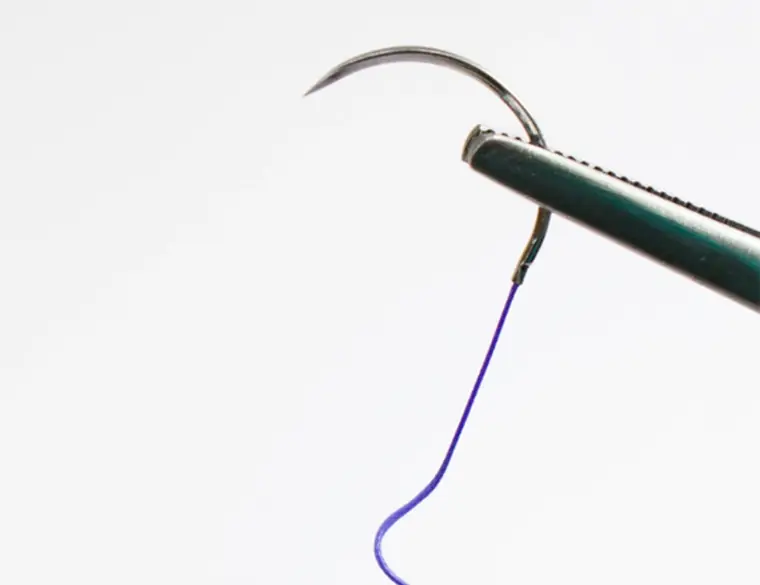
Polyglactin 910 Sutures
Braided · coated · synthetic absorbable
Predictable 75% tensile retention at 14 days and hydrolytic absorption in 56–70 days for soft-tissue approximation and ligation.

Polydioxanone (PDO/PDS)
Monofilament · extended wound support
Long-term strength profile — approx. 50% retention at 4 weeks and absorption in 180–210 days — for fascia, abdominal wall and paediatric surgery.
Polypropylene Sutures
Monofilament · inert · permanent
Non-capillary, non-absorbable closure with minimal tissue reaction — the reference material for cardiovascular, vascular and hernia fixation.
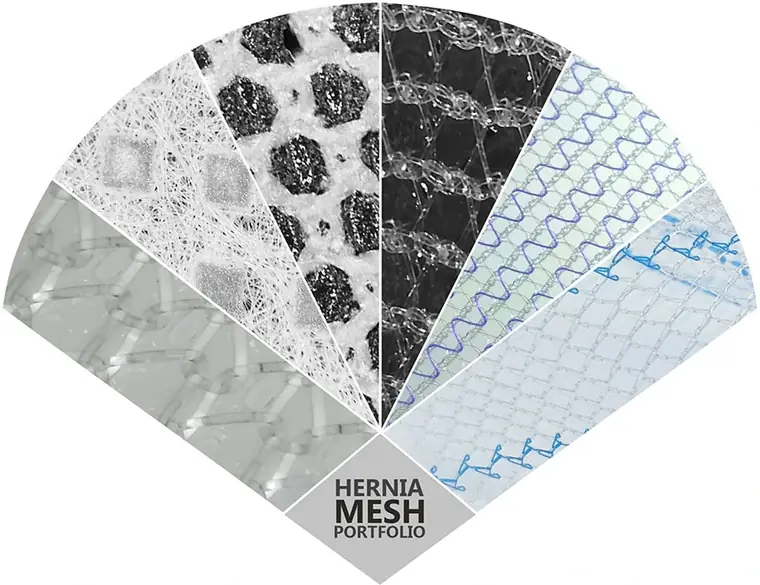
Polypropylene Hernia Mesh
Warp-knitted · macroporous · monofilament
Lightweight to standard-weight constructions with laser-cut edges, pre-shaped anatomical options and sterile single-sheet packing.
Built for importers, tenders and OEM brands.
We supply the product and the paperwork that keeps your registration, tender bid and hospital audit moving.
Registration-ready dossiers
Declaration of Conformity, CE and ISO certificates, Free Sale Certificate, CoA, biocompatibility and sterility validation reports issued with the first shipment — not after the audit.
Lead times you can bid on
Catalogue codes typically dispatch in 2–4 weeks; private-label programmes in 5–7 weeks after artwork sign-off, with buffer stock held for repeat tender volumes.
OEM & private label
Your brand on foil, box and IFU: multi-language leaflets, UDI/GS1 barcodes, custom colour coding and country-specific labelling handled in-house.
Needle & thread configurability
Any combination of USP size, thread length (45–150 cm), needle curvature (1/4, 3/8, 1/2, 5/8 circle), point geometry and armed/double-armed format.
Validated sterility & shelf life
Ethylene-oxide cycles validated to a sterility assurance level of 10⁻⁶, residual limits per ISO 10993-7, and real-time plus accelerated ageing supporting a 5-year shelf life.
Batch-level accountability
Each lot links polymer batch, needle lot, coating record, sterilisation cycle and release test data — retrievable for 11 years for post-market surveillance.
One facility, from polymer pellet to sterile foil.
Extrusion, braiding, coating, precision needle swaging, laser drilling, ethylene-oxide sterilisation and final packing all run inside our Bengaluru plant. Because no step is outsourced, we can trace a finished pack back to the polymer lot, the swage pull-out test and the sterilisation cycle chart — and we release nothing that fails USP tensile or needle-attachment limits.
Absorbable suture performance at a glance.
Indicative in-vivo behaviour of our absorbable families. Lot-specific data, full USP test results and IFUs are available in the datasheet library.
| Material / Brand | Structure | Tensile retention | Absorption (full) | USP size range | Typical use |
|---|---|---|---|---|---|
| Polyglactin 910 — Netcryl | Braided, coated | ≈75% @ 14 d · 50% @ 21 d | 56–70 days | 8-0 to 2 | General, OB/GYN, dental |
| Polyglactin 910 Rapid | Braided, coated | ≈50% @ 5 d | 40–45 days | 6-0 to 2-0 | Skin, mucosa, paediatrics |
| Polyglycolic Acid — Netsorb | Braided, coated | ≈60–70% @ 14 d | 60–90 days | 7-0 to 2 | General, gynaecology |
| Poliglecaprone 25 — Netcryl Mono | Monofilament | ≈50–60% @ 7 d | 91–119 days | 6-0 to 1 | Subcuticular, plastics |
| Polydioxanone — Netsynth | Monofilament | ≈70% @ 14 d · 50% @ 28 d | 180–210 days | 7-0 to 2 | Fascia, abdominal wall |
| Chromic Catgut — Netgut | Twisted collagen | Support 21–28 d | Approx. 90 days | 6-0 to 2 | Mucosa, ligation, dental |
Values are indicative laboratory and literature ranges for material selection guidance and do not replace the Instructions for Use. Request the controlled datasheet for regulatory submissions.
Shipping wound closure to 50+ countries.
Distributor partnerships, hospital group supply and public-sector tenders — supported by region-specific labelling and registration documentation.
Regional coverage & support
18 active markets
High-volume absorbable and silk suture supply for hospital groups and government tenders, with CFS and legalised documents prepared for local health authorities.
- Philippines
- Vietnam
- Indonesia
- Malaysia
- Nepal
- Sri Lanka
- Bangladesh
- Australia (OEM)
12 active markets
Private-label suture and hernia mesh programmes with Arabic IFUs, SFDA/MoH-aligned labelling and shipment consolidation from Nhava Sheva and Chennai.
- UAE
- Saudi Arabia
- Qatar
- Oman
- Iraq
- Jordan
- Yemen
9 active markets
Tender-focused supply of catgut, silk, PGA and skin staplers with French/English dual-language leaflets and pre-shipment inspection support.
- Nigeria
- Kenya
- Ethiopia
- Tanzania
- Ghana
- Egypt
- Morocco
7 active markets
CE / EU MDR technical files, Authorised Representative coordination, UDI data and EUDAMED-ready labelling for EU importers and distributors.
- Germany
- Spain
- Italy
- Poland
- Türkiye
- United Kingdom
6 active markets
Spanish and Portuguese labelling, ANVISA/INVIMA-oriented dossiers and mesh plus suture kit bundles for surgical distributors.
- Brazil
- Mexico
- Colombia
- Peru
- Chile
- Ecuador
What distributors and OEM brands report.
Feedback collected from long-term import partners after registration, first tender delivery and repeat orders.
“The technical file arrived complete on the first attempt — Declaration of Conformity, CoA, sterility validation. Our ministry registration closed in one review cycle instead of three.”
“We launched a private-label absorbable line in under three months. Artwork, UDI barcodes and four-language IFUs were handled by their regulatory team, not ours.”
“Knot security and needle sharpness stayed consistent lot after lot across three tender deliveries — that consistency is what keeps our surgeons specifying the brand.”
The files your regulatory team will ask for.
Maintained under our ISO 13485:2016 quality system and issued on company letterhead with batch-specific data where applicable.
Matched to the procedure, not just the catalogue.
Our application engineers recommend material, USP size and needle geometry per procedure — from 10-0 ophthalmic monofilament to size 2 orthopaedic braids.
Cardiovascular & vascular
Polypropylene and PTFE monofilaments in 8-0 to 2-0, double-armed with taper or taper-cut needles and optional pledgets.
Hernia & general surgery
Macroporous polypropylene mesh, 3D anatomical and partially absorbable constructions with polypropylene or PDO fixation sutures.
Orthopaedic & sports medicine
High-tensile UHMWPE and braided polyester in tape and round formats for tendon repair, ligature loops and fixation constructs.
Suture sourcing, answered directly.
The questions our export desk receives most often from importers, tender agents and OEM brands.
What does Suture Planet manufacture?
Where are the products made and how traceable is production?
Which certifications support product registration in my country?
Do you offer OEM and private-label suture manufacturing?
What are typical minimum order quantities and lead times?
How are sterility and shelf life assured?
Which suture should I select for skin closure versus fascia?
Partner with a documented suture manufacturer.
Distributor appointments, OEM programmes and tender supply — with technical files, samples and registration support prepared by our export desk.