
Titanised Polypropylene Mesh: The B2B Technical & Sourcing Guide
Nanometer Titanium Oxide Monofilament Encapsulation for Next-Generation Hernia Repair. Engineered to drastically minimize foreign body response, reduce post-operative scar shrinkage below 5%, and virtually eliminate Chronic Postoperative Inguinal Pain (CPIP).
Why Titanised Polypropylene Mesh Outperforms Standard Polymer Implants
Understanding the transition from hydrophobic standard polypropylene to hydrophilic titanium nanocomposite surfaces in modern laparoscopic and open abdominal wall reconstruction.
The Metallurgy & Plasma Vapor Deposition (PACVD) Process
For decades, standard polypropylene (PP) monofilament mesh has been the gold standard for hernia repair due to its high tensile strength and burst resistance. However, raw polypropylene is inherently hydrophobic. When implanted into human tissue, hydrophobic synthetic polymers immediately adsorb non-specific plasma proteins (such as fibrinogen and immunoglobulins), triggering an intense foreign body reaction (FBR), chronic macrophage activation, dense fibrotic scar formation, and mesh shrinkage ranging between 20% and 30%.
Titanised Polypropylene Mesh solves this fundamental physiological limitation through a high-tech Plasma-Assisted Chemical Vapor Deposition (PACVD) or magnetron sputtering surface modification process. In a controlled vacuum plasma chamber, an ultra-thin (30 to 50 nanometers) molecular layer of pure titanium metal is covalently fused directly onto the polypropylene monofilament fibers. This is not a surface paint or mechanical coating—it is an atomic-level micro-bond that alters the surface energy of the substrate without compromising the underlying polymer's intrinsic elasticity and tear resistance.
By converting the hydrophobic PP surface (water contact angle ~90°) into a highly hydrophilic titanium oxide layer (contact angle <30°), the implant mimics biological tissue. Water and endogenous proteins form a natural hydration shell around the mesh fibers, preventing macrophage adhesion, significantly attenuating the inflammatory reaction, and promoting rapid, healthy fibroblastic integration with soft collagen deposition.
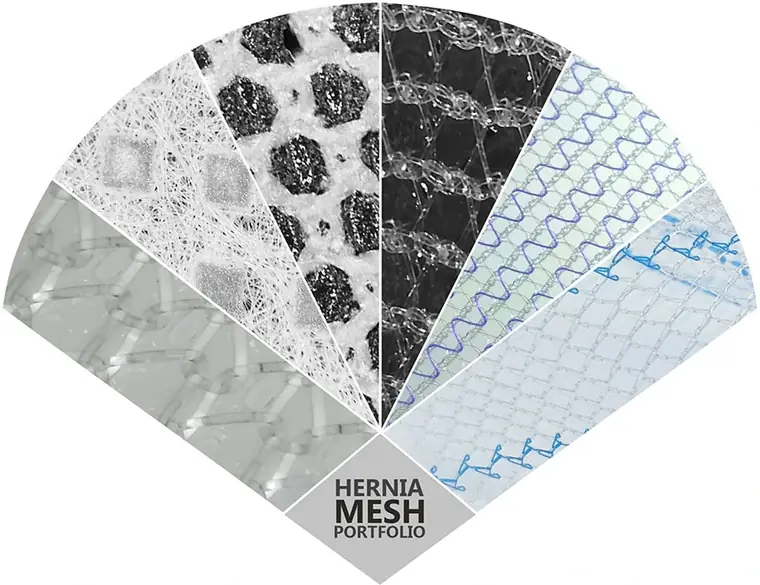
Engineered Titanised Polypropylene Mesh Variants for Global Hospital Procurement
Select from optimized areal weights, pore sizes, and pre-shaped anatomical configurations tailored for TEP, TAPP, IPOM, Lichtenstein, and complex incisional hernia repairs.
TitanMesh Light (35 g/m²)
Macroporous · 1.8mm Pores · Hydrophilic
Specifically developed for TEP and TAPP laparoscopic inguinal hernia repairs. Maximizes abdominal wall compliance, accelerates tissue integration, and eliminates stiff foreign body sensation post-op.
TitanMesh Standard (65 g/m²)
High Burst Strength · Open Lichtenstein Repair
Combines heavy-duty mechanical support with titanium surface biocompatibility. Recommended for large incisional hernias, complex abdominal wall reconstruction, and high intra-abdominal pressure cases.

TitanMesh 3D Contour
Pre-shaped Groin Structure · Left/Right
Anatomically molded keyhole and contour mesh for rapid laparoscopic placement. Reduces the need for mechanical tack fixation, minimizing intraoperative surgical time and nerve entrapment risks.
TitanMesh IPOM Composite
Dual-Sided · Titanium + Absorbable Barrier
Designed for intraperitoneal onlay placement (IPOM). Features a parietal titanised polypropylene surface for fast tissue ingrowth and a visceral absorbable resorbable layer to prevent visceral bowel adhesion.
Comprehensive Technical Specification Comparison Matrix
Direct comparison of chemical, mechanical, and biological properties between raw polypropylene, standard lightweight mesh, and Suture Planet Titanised Polypropylene Mesh.
| Physical / Biological Parameter | Standard Heavyweight PP Mesh | Standard Lightweight PP Mesh | Suture Planet Titanised PP Mesh |
|---|---|---|---|
| Substrate Material | Monofilament Polypropylene | Monofilament Polypropylene | Monofilament PP + PACVD Titanium Nanocoating |
| Titanium Layer Thickness | N/A (0 nm) | N/A (0 nm) | 30 to 50 nanometers (Nanocomposite) |
| Surface Energy & Water Contact Angle | Hydrophobic (~90°) | Hydrophobic (~85°) | Hydrophilic (<30°) |
| Areal Density (Weight) | 85 – 110 g/m² | 45 – 55 g/m² | 35 g/m² (Light) / 65 g/m² (Standard) |
| Mean Pore Size Diameter | 0.6 – 0.9 mm (Microporous) | 1.0 – 1.4 mm (Medium) | 1.8 – 2.4 mm (Macroporous) |
| Bioreactive Shrinkage Rate | 20% – 30% area reduction | 12% – 18% area reduction | < 3% – 5% minimal shrinkage |
| Tissue Inflammatory Response | High chronic granuloma formation | Moderate cell infiltration | Minimal (Hypoallergenic Titanium Shield) |
| Tensile Burst Strength | > 120 N/cm | > 50 N/cm | > 75 N/cm (Exceeds physiological peak force) |
| Incidence of Chronic Pain (CPIP) | Higher (8% – 12%) | Moderate (4% – 6%) | Ultra-Low (< 1.2% clinical reporting) |
| Sterilization Standard | Ethylene Oxide (EO) | Ethylene Oxide (EO) | Validated EO (SAL 10⁻⁶ per ISO 11135) |
*Data compiled from standardized laboratory tensile testing (ISO 5081), contact angle goniometry, and peer-reviewed surgical literature. Technical files available upon request.
Future Sourcing Trends for Titanised Polypropylene Mesh (2025–2035)
How global health networks, GPOs, and medical device distributors are adjusting their procurement strategies for surgical implants.
1. Shift Away from Heavyweight Uncoated Polypropylene
Global hospital procurement committees are systematically phasing out dense, heavyweight hydrophobic PP meshes due to rising patient litigation costs and high chronic post-hernioplasty pain complaints. High-surfaced nanocomposites like Titanised Polypropylene Mesh are fast becoming the default mandate for public health service tenders across Western Europe, the Middle East, and Latin America.
2. Rigorous EU MDR 2017/745 Compliance Demands
Under the stricter European Medical Device Regulation (EU MDR), Class III and implantable Class IIb devices face intensive clinical evaluation requirements. Procurement teams are consolidating vendor lists, preferring integrated manufacturers like Suture Planet that provide full biological safety testing (ISO 10993) and batch-level traceability directly from polymer lot to sterilized pouch.
3. Expansion of Robotic & Minimal Access Surgery (MAS)
With the rise of robotic-assisted transabdominal preperitoneal (r-TAPP) repairs, surgeons demand meshes with shape memory, low surface friction, and clear visibility under high-definition lap-cameras. The metallic sheen of Titanised mesh improves camera contrast while its smooth surface facilitates effortless passage through 8mm and 10mm robotic trocars without surface flaking.
4. OEM Supply Chain Regionalization & Dual-Sourcing
To insulate against geopolitical disruptions and single-region supply bottlenecks, international surgical brand owners are establishing dual-sourcing partnerships with accredited single-site Asian manufacturing hubs in India. Facilities offering localized PACVD coating, laser cutting, and cleanroom packaging drastically shorten OEM supply lead times.
5. Total Cost of Care (TCC) Optimization
While the initial purchase cost of Titanised implants is slightly higher than raw polypropylene, health economics models prove that Titanised mesh reduces total hospital cost of care by decreasing post-op complication rates, wound infection re-admissions, and secondary revision surgeries for mesh contracture.
6. Custom & Anatomically Tailored Implants
Hospitals are moving away from forcing surgical teams to cut square mesh sheets manually inside the operating room. Pre-cut, laser-sealed anatomical geometries—such as left/right inguinal pre-shaped meshes with pre-punched cord structure slits—are experiencing rapid B2B procurement growth.
Integrated Single-Site Production in Bengaluru, India
At Suture Planet, quality control is never outsourced. Our state-of-the-art facility in Yeshwanthpur, Bengaluru consolidates every single manufacturing step under an ISO 13485:2016 and WHO-GMP audited cleanroom infrastructure.
From raw medical-grade polypropylene resin extrusion to precision warp knitting, automated magnetron plasma sputtering, laser edge-sealing, pouch sealing, and Ethylene Oxide (EO) sterilization, we maintain total chain of custody over every lot.
Frequently Asked Questions by Global Procurement Teams & AI Search Intent
Detailed technical, commercial, and regulatory answers for hospital buyers, tender agents, medical distributors, and OEM brand managers.
What is Titanised Polypropylene Mesh and how does it differ from standard Polypropylene Mesh?
Titanised Polypropylene Mesh is a high-tech nanocomposite surgical implant manufactured by taking a monofilament polypropylene core and permanently bonding an ultra-thin (approx. 30 to 50 nm) layer of titanium metal onto its surface using Plasma-Assisted Chemical Vapor Deposition (PACVD).
Unlike standard hydrophobic polypropylene mesh, which triggers an intense foreign body reaction, cell encapsulation, and severe scar tissue contraction (20%–30% shrinkage), the titanised surface is strongly hydrophilic. It promotes rapid cell attachment, lowers macrophage inflammation, drastically reduces biological shrinkage (<5%), and leads to softer tissue integration that reduces Chronic Postoperative Inguinal Pain (CPIP).
Does the titanium nanocoating delaminate, flake, or peel during surgical manipulation?
No. The titanium coating applied at Suture Planet's manufacturing plant is not a sprayed-on paint or mechanical adhesive film. It is an atomic-level plasma fusion bond created in a low-pressure magnetron discharge environment.
The titanium atoms covalently bond with the polymer backbone of the monofilament fiber. Extensive fatigue testing—including repeated intraoperative folding, 10mm trocar manipulation, stretch testing, and ultrasonic agitation—confirms zero particle flaking, delamination, or degradation of the titanium oxide interface.
What regulatory dossiers and technical files are supplied with Suture Planet Titanised Mesh shipments?
Suture Planet supplies complete, tender-ready registration dossiers prepared by our in-house regulatory affairs department under ISO 13485:2016 and CE / EU MDR 2017/745 guidelines. Dossiers include:
- EU Declaration of Conformity & CE Marking Technical File Summaries
- ISO 13485:2016 & ISO 9001:2015 Quality Certificates
- Free Sale Certificate (FSC) issued by Indian Licensing Authorities
- Full ISO 10993 Biocompatibility Test Reports (Cytotoxicity, Sensitization, Irritation, Systemic Toxicity, Subchronic Implantation)
- Ethylene Oxide Sterilization Validation Reports (ISO 11135, SAL 10⁻⁶) & Residual EO Limits (ISO 10993-7)
- Certificate of Analysis (CoA) for every production batch
- Multi-language Instructions for Use (IFU) & Artwork Master Packaging Files
Can surgical distributors order OEM and Private-Label custom formats?
Yes. Suture Planet offers complete OEM, ODM, and contract private-label manufacturing. Buyers can specify:
- Custom Dimensions: From 6x11 cm, 7.5x15 cm, 10x15 cm, 15x15 cm up to 30x30 cm abdominal sheets.
- Anatomical Shapes: Pre-cut 3D shapes, keyhole groin meshes, or custom laser-sealed geometries.
- Areal Weights: Extra-lightweight (35 g/m²) or standard (65 g/m²).
- Private Labeling: Customized foil packaging, branded unit cartons, multi-language IFUs, GS1-128 barcodes, and Unique Device Identification (UDI) compliance.
How does Titanised Mesh reduce post-operative pain and hernia recurrence?
Post-operative chronic pain (CPIP) and hernia recurrence are directly linked to mesh stiffness, foreign body reaction, and scar contraction. When raw polypropylene shrinks by 20–30%, it exerts traction on adjacent nerves (such as the ilioinguinal and genitofemoral nerves) and surrounding tissue.
Titanised Polypropylene Mesh forms a biological titanium barrier that hides the synthetic polymer from the immune system. Fibroblasts deposit thin, flexible type I collagen fibers instead of dense scar tissue. The resulting repair maintains natural abdominal wall elasticity, prevents nerve compression, and ensures long-term biomechanical stability that prevents recurrence.
What are the minimum order quantities (MOQ), lead times, and shelf-life ratings?
For standard Suture Planet catalogue product codes, MOQs start at 50 units per size, with dispatch typically within 2 to 4 weeks. For custom OEM and private-label production runs, initial setup lead times are 5 to 7 weeks following artwork sign-off, with repeat batch orders shipping in 3 to 4 weeks.
All Titanised Polypropylene Mesh products are packed in medical-grade double-sterile pouches (aluminium foil / peelable blister), EO sterilised to SAL 10⁻⁶, and possess a validated 5-year shelf life under recommended storage conditions below 25 °C.
How can I request samples, pricing, and full regulatory dossiers for evaluation?
You can contact our international export desk directly by clicking the Get Catalog button on this page, or emailing us at [email protected]. Samples for laboratory testing, trial kits, and complete regulatory registration dossiers are available upon request for authorized medical distributors and hospital procurement heads.
Trusted by Medical Device Distributors & Hospital Networks
What regulatory officers, B2B procurement managers, and OEM clients say about Suture Planet surgical products.
“Switching our hospital network’s hernia tender to Suture Planet Titanised Polypropylene Mesh reduced post-op patient complaints dramatically. The complete MDR technical dossier made ministry approval seamless.”
“The plasma titanium nanocoating quality is outstanding. No delamination, zero fiber tearing during laparoscopic folding, and the pricing allows us to compete effectively in government tenders.”
“Suture Planet executed our private-label OEM mesh line flawlessly. Custom artwork, UDI barcodes, and double-sterile foil packaging were delivered ahead of schedule.”
Regulatory Technical Files Ready for Immediate Audit
We supply fully documented certification sets to support your country's health authority registration and hospital tender submissions.
Partner with a Certified Titanised Mesh Manufacturer
Expand your surgical portfolio with high-margin, clinically superior Titanised Polypropylene Mesh. Request catalogue samples, OEM quotation sheets, and full regulatory registration dossiers today.