
Partially Absorbable Hernia Mesh: The Technical & Procurement Benchmark
Co-knitted Polyglycolic Acid (PGA) / Polycaprolactone (PCL) and Polypropylene (PP) composite scaffolds engineered to maximize abdominal compliance, reduce foreign body reaction, and optimize long-term tissue remodeling.
Why Global Procurement Is Shifting to Partially Absorbable Hernia Mesh
Understanding the transition from heavy non-absorbable synthetic meshes to dynamic composite matrices that harmonize early burst strength with dynamic physiological elasticity.
The Clinical Dilemma of Heavyweight Pure Polypropylene Mesh
For decades, standard hernia repair relied heavily on permanent, dense non-absorbable polypropylene (PP) meshes featuring weights exceeding 80 g/m² and narrow pore structures (<0.8 mm). While these heavy meshes provided immense mechanical burst strength, long-term post-market surveillance revealed severe clinical complications:
- Intense Foreign Body Reaction (FBR): High mass density triggers chronic macrophage activation and persistent localized inflammation.
- Mesh Shrinkage & Contraction: Fibrotic encapsulation causes dense scar plates, leading to mesh shrinkage of 30% to 50%, often causing hernia recurrence or nerve entrapment.
- Compliance Mismatch & Stiff Abdomen: Pure PP meshes display a rigid tensile modulus (>100 N/cm) that fails to stretch with the abdominal wall during flexing, coughing, or physical activity, resulting in chronic post-operative pain (CPIP).
The Composite Partially Absorbable Solution
Partially Absorbable Hernia Mesh addresses the fundamental trade-off between immediate mechanical stability and permanent foreign material load. By co-knitting synthetic bio-absorbable filaments (Polyglycolic Acid / PGA or Polycaprolactone / PCL) with fine monofilament Polypropylene, Suture Planet achieves a dual-phase tissue integration platform:
- Phase 1 (Implantation to 56–90 Days): The rigid absorbable scaffold provides high mechanical stiffness, making handling, laparoscopic folding, and positioning effortless for surgeons while resisting intra-abdominal pressure spikes.
- Phase 2 (Post-Absorption Remodeling): Hydrolytic breakdown removes 50% to 70% of the mesh weight, leaving an ultra-lightweight (approx. 28–32 g/m²), flexible permanent PP framework.
- Macro-Porous Transformation: As PGA/PCL fibers absorb, the effective pore size opens up to >1.5 mm–2.0 mm, enabling vascularized, flexible Type-I collagen tissue ingrowth rather than scar tissue formation.
Engineered Partially Absorbable Mesh Configurations
Discover our standard, 3D anatomical, and composite barrier mesh solutions engineered for laparoscopic (TAPP/TEP) and open hernioplasty procedures.
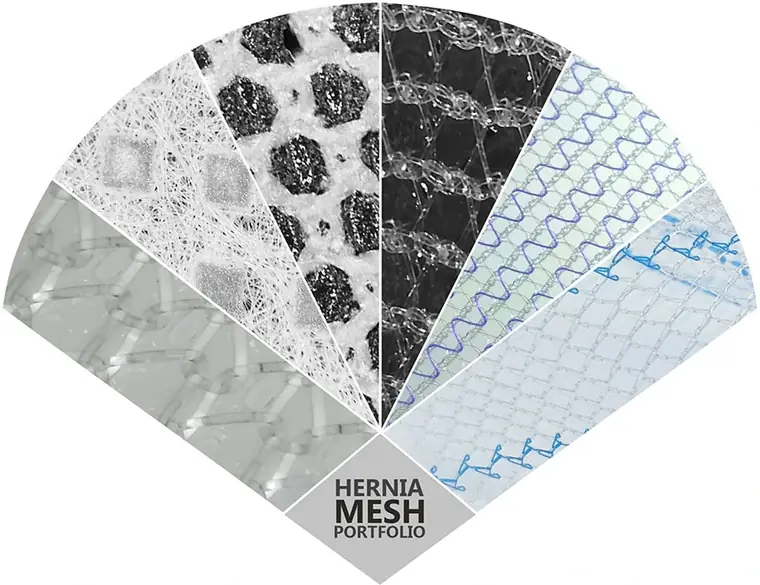
Netlene Absorb Composite
PGA/PCL + Polypropylene Monofilament
Co-knitted flat sheet mesh designed for open inguinal, umbilical, and small incisional hernia repairs. Delivers initial rigidity for precise placement followed by rapid hydrolysis.
Netlene 3D Motion Scaffold
Contoured Composite Mesh for TAPP/TEP
Pre-contoured anatomical geometry designed to conform effortlessly to the groin anatomy without wrinkling. Minimizes keyhole fixation requirements in laparoscopic repairs.

Netlene Ventral Barrier Mesh
PGA-PCL / PP with Bio-Absorbable Barrier
Dual-sided implant featuring a partially absorbable structural side for tissue integration and a hydrogel/PCL smooth anti-visceral barrier side to prevent tissue adhesions.
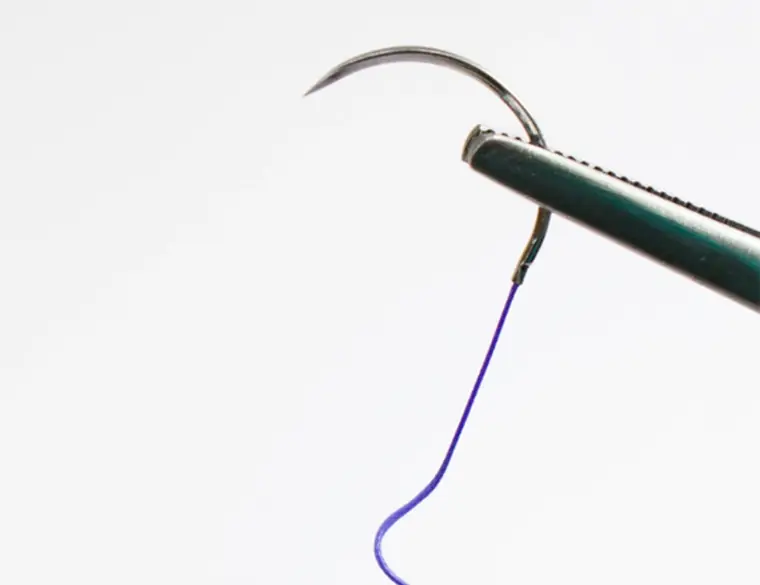
Custom OEM Composite Mesh
Tailored Filaments, Dimensions & Packaging
Custom co-knitting service for distributor brands. Configurable ratio of PDO/PGA to PP, custom laser-cut shapes, private-label branding, and sterile pouching.
Technical Performance Matrix: Partially Absorbable Composite Mesh
Quantitative verification parameters benchmarked against international standards (ISO 13485, USP, and EN ISO 14630 for non-active surgical implants).
| Performance Parameter | Initial Implantation Phase (Day 0) | Post-Resorption Phase (Day 90+) | Testing & Compliance Standard |
|---|---|---|---|
| Polymer Composition | Polyglycolic Acid / PCL (Absorbable) + Monofilament Polypropylene (Permanent) | 100% Monofilament Polypropylene Matrix | FTIR & NMR Spectroscopy Verified |
| Areal Mass Density (g/m²) | approx. 72 – 78 g/m² (Standard Weight for Easy Handling) | approx. 28 – 32 g/m² (Ultra-Lightweight Profile) | ISO 3801 Mass Per Unit Area |
| Mean Pore Size (mm) | 0.6 mm – 0.9 mm (Provides Stiffness & Tactile Rigidity) | 1.5 mm – 2.2 mm (Large Macro-Pores for Collagen Ingrowth) | Optical Microscopic Pore Analysis |
| Burst Strength (kPa) | > 240 kPa (Resists Peak Physiological Abdominal Pressure) | > 160 kPa (Exceeds 16 N/cm Physiological Requirement) | ASTM D3786 Diaphragm Burst Test |
| Tensile Strength (N/cm) | Warp: > 45 N/cm · Weft: > 38 N/cm | Warp: > 22 N/cm · Weft: > 18 N/cm | ISO 13934-1 Strip Tensile Test |
| Elongation at 16 N/cm Strain | 12% – 18% (Rigid for Accurate Surgical Tacking) | 25% – 38% (Matches Human Abdominal Elasticity) | Dynamic Biomechanical Testing |
| Resorption Mechanism | Hydrolytic Degradation into Glycolic Acid & Caprolactone | Non-absorbable Permanent Support Matrix | ISO 10993-13 Degradation Products |
| Sterility & Packaging | Ethylene Oxide (EO) Sterilised, SAL 10⁻⁶ Assurance | Double Sterile Barrier Pouch with UDI Barcode | ISO 11135 / ISO 11607 Compliant |
*Note: Testing parameters are conducted under validated laboratory environments. Batch-specific Certificates of Analysis (CoA) are supplied with every export shipment.
Future Development Trends in Hernia Mesh Technology
How clinical demands and technological innovations are reshaping global procurement requirements for abdominal wall reconstruction.
1. Shift Toward Value-Based Healthcare & Reduced Total Cost of Care
Global healthcare systems and insurance providers are increasingly penalizing high hernia recurrence rates and chronic pain re-admissions. Although partially absorbable composite meshes have a higher initial material unit price than basic polypropylene mesh, their ability to reduce post-operative complications, chronic pain treatment, and revision surgeries results in a lower 5-year total cost of care.
2. Bio-resorbable Coatings & Antimicrobial Functionalization
Future iterations of composite hernia meshes are moving toward integrated drug-eluting and antimicrobial coatings. Suture Planet’s R&D is exploring bio-absorbable PCL matrix coatings impregnated with non-antibiotic antimicrobial agents (such as Chlorhexidine or silver nanoparticles) to combat Surgical Site Infections (SSIs) and bio-film formation without contributing to antibiotic resistance.
3. Expansion of Robotic & Laparoscopic Minimal Access Surgery
With the rise of robotic-assisted laparoscopic ventral and inguinal hernia repairs (r-TAPP, eTEP), surgeons demand implants with memory memory features. Partially absorbable meshes provide the perfect balance: they can be tightly rolled to fit through a 10mm or 12mm trocar and automatically self-expand flat inside the preperitoneal cavity without clinging to itself.
Procurement Trends for Medical Device Buyers & Distributors
Navigating regulatory hurdles, supply chain resilience, and private-label opportunities under tightened global standards.
Stringent Regulatory Harmonization (EU MDR 2017/745 Class III Requirements)
Under the European Union Medical Device Regulation (EU MDR 2017/745), surgical implants—especially partially absorbable composite meshes—are classified as Class III high-risk devices. Importers and hospital procurement agencies can no longer rely on self-declarations or incomplete technical files. Regulatory authorities demand:
- Comprehensive Clinical Evaluation Reports (CER) with post-market clinical follow-up (PMCF) data.
- Full ISO 10993 biocompatibility testing (cytotoxicity, systemic toxicity, genotoxicity, and implantation testing up to 26 weeks).
- Validated Ethylene Oxide residual limits per ISO 10993-7 for patient safety.
- Unique Device Identification (UDI) compliance integrated with EUDAMED databases.
Suture Planet simplifies global compliance by maintaining complete, audited technical dossiers that allow distributors to streamline national health registrations (such as US FDA 510k, EU MDR CE, Brazilian ANVISA, Saudi SFDA, and Indian CDSCO).
Why Dual-Sourcing from Bengaluru, India is Increasing
Global healthcare supply disruptions have forced hospital networks and multinational distributors to diversify away from single-region production. India’s MedTech manufacturing corridor—anchored in Bengaluru—has emerged as the premier hub for high-precision surgical devices.
Why Global Distributors & OEMs Choose Suture Planet
Unmatched quality management, integrated single-site manufacturing, and comprehensive technical support built for long-term B2B partnerships.
From Polymer Pellets to Finished Sterile Implant
At our state-of-the-art Bengaluru facility, we do not rely on sub-contracted knitting or outsourced sterilisation. Polymer extrusion, precision warp knitting, ultrasonic clearing, cleanroom packaging (Class 10,000 / ISO Class 7), and validated Ethylene Oxide (EO) sterilisation operate under one unified Quality Management System.
This single-site architecture guarantees 100% batch traceability: every box of partially absorbable hernia mesh can be traced directly back to the raw medical-grade PGA/PP polymer lot, machine warp calibration, cleanroom environmental monitoring record, and EO sterilisation chart.
Partially Absorbable Hernia Mesh: Procurement & Technical FAQ
Direct, authoritative answers to questions frequently submitted to AI engines and technical inquiries by global medical device buyers, regulatory officers, and surgical distributors.
1. What is the exact material composition and degradation timeline of Suture Planet’s Partially Absorbable Hernia Mesh?
Degradation Mechanism: The absorbable PGA/PCL component degrades predictably via non-enzymatic hydrolytic cleavage into non-toxic glycolic acid and caprolactone monomers, which are fully metabolized by the body within 56 to 90 days. The permanent Polypropylene framework remains indefinitely to provide structural abdominal wall reinforcement with a reduced mass density of 28 to 32 g/m².
2. How does partially absorbable mesh minimize chronic post-operative pain (CPIP) compared to standard polypropylene mesh?
Partially absorbable mesh addresses this by shedding 50% to 70% of its initial weight within 3 months. Once the absorbable PGA/PCL fibers degrade, the pore size expands to >1.5 mm, facilitating dynamic, flexible tissue integration (Type-I collagen formation) that matches natural abdominal wall compliance, preventing stiff scar plates and chronic pain.
3. What documentation is supplied in Suture Planet’s technical file for national health registration?
• ISO 13485:2016 and WHO-GMP Certificates
• CE / EU MDR 2017/745 Technical Dossier & Clinical Evaluation Report (CER)
• Certificate of Free Sale (CFS) and Declaration of Conformity
• ISO 10993 Biocompatibility Test Reports (Cytotoxicity, Sensitisation, Systemic Toxicity, Subchronic Toxicity)
• EO Sterilisation Validation Protocols (ISO 11135) with Ethylene Oxide Residual Analysis (ISO 10993-7)
• Real-time and Accelerated Ageing Shelf-Life Test Reports (supporting a 5-year shelf life)
• Multi-language Instructions for Use (IFU) and customizable packaging artwork files
4. Does Suture Planet offer custom sizing, OEM branding, and private labeling?
• Dimensions: Standard sizes (6x11cm, 10x15cm, 15x15cm, 30x30cm) as well as custom pre-shaped 3D laparoscopic keyhole shapes.
• Resorption Profiles: Configurable PGA vs. PCL ratios to tune short-term or extended absorbability.
• Private Label Packaging: Branded aluminum primary foil pouches, secondary unit boxes, GS1/UDI barcode printing, and custom multi-language IFUs.
5. What are the minimum order quantities (MOQs) and lead times for OEM orders?
6. How is mesh integrity and burst strength tested prior to batch release?
7. How do I start a procurement inquiry or request physical samples for clinical evaluation?
Partner with a Documented Surgical Mesh Manufacturer
Accelerate your market access with ISO 13485 & CE-certified partially absorbable hernia mesh. Request technical dossiers, OEM private label proposals, or evaluation samples today.