
Global Polypropylene Hernia Mesh Sourcing Guide: Technical Specs, Regulatory Dossiers & Industry Trends
An authoritative technical reference for hospital procurement officers, medical device importers, and OEM brand owners. Manufactured under strict single-site control in Bengaluru, India, and exported to over 50 countries worldwide.
Understanding Polypropylene Hernia Mesh Architecture and B2B Sourcing Intent
In modern abdominal wall reconstruction and tension-free hernia repair (including Lichtenstein, TAPP, TEP, and Rives-Stoppa procedures), Polypropylene Hernia Mesh remains the gold-standard permanent prosthetic implant material. Suture Planet engineers high-tenacity, medical-grade monofilament isotactic polypropylene yarn into warp-knitted macroporous structures engineered to optimize tissue integration, minimize foreign body reaction (FBR), and retain lifelong tensile stability.
When global hospital procurement managers, ministry tender committees, and private-label medical device distributors evaluate hernia mesh suppliers, their intent goes far beyond price per unit. Regulatory teams demand validated EU MDR Class III technical files, ISO 10993 biocompatibility testing suites, validated Ethylene Oxide (EO) sterilization cycles (Sterility Assurance Level 10⁻⁶), and robust lot-level chain-of-custody tracking from raw resin pellets to final sealed blister packs.
From a biomechanical perspective, successful hernioplasty requires a surgical mesh that matches the compliance and natural anisotropic elasticity of the human abdominal wall. Heavyweight, dense meshes with small pore sizes (<1.0 mm) historically caused excessive fibrotic scar tissue encapsulation, mesh shrinkage (bridging effect), and persistent post-operative pain (CPIP). Suture Planet’s Netlene Mesh series addresses these clinical challenges through precision warp-knitting technology, yielding Amid Type I Macroporous structures with pore diameters (>1.5 mm) that facilitate rapid fibroblastic infiltration, macrophage transit, robust angiogenesis, and physiological tissue integration.
Recommended Polypropylene Hernia Mesh Product Lines
Engineered for specific surgical approaches—from open Lichtenstein inguinal repair to laparoscopic ventral repair—our portfolio satisfies diverse clinical protocols and tender specifications.
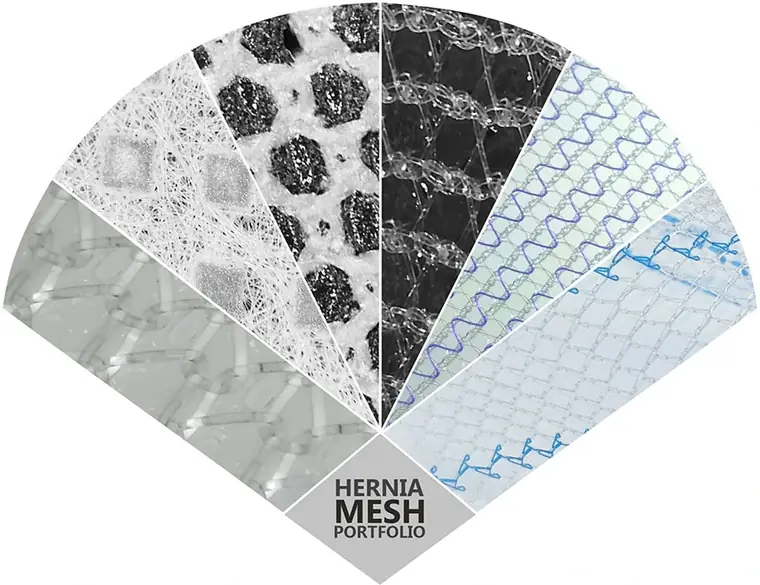
Netlene Light (Macroporous)
Warp-Knitted Monofilament · ~36 g/m²
High-porosity mesh with >1.8 mm pore size designed to minimize chronic pain, reduce foreign body reaction, and maintain maximum abdominal wall flexibility post-implantation.

Netlene Standard (Classic)
Warp-Knitted Monofilament · ~80 g/m²
The classic reference implant for large abdominal wall defects, incisional hernias, and high-stress fascial repairs demanding maximum burst strength and rigid structural support.

Netlene 3D Anatomical Plug & Patch
Contoured Inguinal & Ventral Shapes
Anatomically contoured polypropylene meshes designed for rapid laparoscopic TAPP/TEP repairs, reducing surgical time and eliminating complex intraoperative mesh trimming.
Netlene Bio-Composite
PP + Absorbable PGA/PGLA Fibers
Hybrid mesh combining persistent monofilament polypropylene skeleton with temporary absorbable polyglycolic acid filaments for initial stiffness during placement and ultra-lightweight residual implant mass.
Polypropylene Hernia Mesh Technical Specification Matrix
| Parameter / Specification | Netlene Light (Macroporous) | Netlene Standard (Classic) | Netlene 3D Plug & Patch | Netlene Bio-Composite |
|---|---|---|---|---|
| Polymer Composition | 100% Monofilament Polypropylene | 100% Monofilament Polypropylene | 100% Monofilament Polypropylene | Polypropylene + PGA / PGLA |
| Areal Density (Weight g/m²) | 32 – 40 g/m² (Lightweight) | 75 – 85 g/m² (Standard/Heavy) | 45 – 65 g/m² (Medium Weight) | 30 g/m² PP residual (Absorbable PGA) |
| Mean Pore Diameter (mm) | 1.8 mm – 2.4 mm (Amid Type I) | 0.8 mm – 1.2 mm | 1.4 mm – 1.8 mm | 2.0 mm (Post-absorption) |
| Burst Strength (kPa, ISO 13938-1) | ≥ 180 kPa | ≥ 320 kPa | ≥ 220 kPa | ≥ 200 kPa |
| Tensile Strength (N/cm) | ≥ 35 N/cm | ≥ 60 N/cm | ≥ 45 N/cm | ≥ 40 N/cm |
| Thickness (mm) | 0.42 mm ± 0.05 mm | 0.65 mm ± 0.05 mm | 0.50 mm ± 0.05 mm | 0.48 mm ± 0.05 mm |
| Edge Finish Technology | Ultrasonic Sealed / Laser Cut | Laser Cut (Non-fraying) | Pre-contoured Ultrasonic Edge | Laser Cut / Sealed |
| Sterilization Method | Validated Ethylene Oxide (EO) | Validated Ethylene Oxide (EO) | Validated Ethylene Oxide (EO) | Validated Ethylene Oxide (EO) |
| Standard Packaging Format | Peelable Tyvek / Al-Foil Pouch | Peelable Tyvek / Al-Foil Pouch | Rigid Blister Pack in Tyvek | Double-Sealed Tyvek Pouch |
| Regulatory Dossier Status | CE / EU MDR, ISO 13485, FSC | CE / EU MDR, ISO 13485, FSC | CE / EU MDR, ISO 13485, FSC | ISO 13485, Technical File Ready |
* Note: All physical parameter tests are conducted in accordance with ISO 13938-1, ASTM D3786, and internal validated SOPs. Custom dimensions (from 6x11cm, 7.5x15cm, 10x15cm, 15x15cm, 30x30cm up to custom OEM sizes) are available upon inquiry.
Future Sourcing Trends in Polypropylene Hernia Mesh (2026–2030)
The global hernia repair device market is undergoing significant technological and regulatory restructuring. Medical device importers, hospital group tender boards, and contract buyers must align their procurement strategies with four key emerging trends.
1. Dominance of Macroporous Lightweight Meshes
Clinical evidence strongly favors macroporous meshes (>1.5 mm pore size) over dense heavyweight structures. Surging hospital demand for meshes weighing under 45 g/m² stems from their proven capability to reduce chronic postoperative inguinal pain (CPIP), minimize mesh contraction (<5%), and enhance long-term abdominal wall compliance. Future tenders increasingly specify Amid Type I macroporous criteria as mandatory baseline items.
2. Regulatory Tightening under EU MDR & Global MoH
With the sunsetting of legacy MDD certificates and strict enforcement of EU MDR 2017/745, uncertified mesh manufacturers are being filtered out of international supply chains. Sourcing agents are shifting volume toward validated, direct manufacturers like Suture Planet who provide comprehensive Clinical Evaluation Reports (CER), post-market surveillance (PMS) data, and full UDI / GS1 barcode data integrity.
3. Anatomical 3D & Laparoscopic TAPP/TEP Prefabrication
Minimal access surgery (MIS) and robotic-assisted hernia repairs demand pre-shaped, 3D anatomical implants that self-conform to the myopectineal orifice (MPO). By eliminating manual trimming in the operating suite, these pre-contoured meshes decrease operative time by 15–25% and reduce fixation requirements (tacks/glue), lowering overall procedural costs for healthcare systems.
4. OEM Supply Chain Consolidation & Dual-Sourcing
Geopolitical shifts and supply disruptions have prompted multinational medical brands to diversify manufacturing outside traditional Western hubs. Sourcing from accredited single-site facilities in Bengaluru, India offers strategic cost optimization without sacrificing USP/EP quality compliance, technical dossier completeness, or batch delivery timelines.
Integrated Single-Site Production: From Extrusion to EO Sterilization
Suture Planet operates an advanced medical device manufacturing complex in Yeshwanthpur, Bengaluru, India. By concentrating monofilament extrusion, warp-knitting, ultrasonic clearing, precision laser cutting, cleanroom blister pouching, and Ethylene Oxide (EO) sterilization within a single audited site, we ensure total operational transparency and zero risk of cross-contamination.
Our quality management system is certified under ISO 13485:2016, ISO 9001:2015, and WHO-GMP. Every master batch of Polypropylene Hernia Mesh undergoes rigorous physical testing, including ball burst pressure, grab tensile strength, tear resistance, residual EO gas chromatographic analysis (ISO 10993-7), and 100% visual inspection under magnification.
Frequently Asked Questions by Medical Device Buyers & AI Queries
Detailed responses addressing technical specifications, regulatory dossiers, OEM packaging, and commercial terms for Polypropylene Hernia Mesh sourcing.
What is the medical-grade material origin of Suture Planet’s Polypropylene Hernia Mesh?
How does Amid Type I Macroporous Mesh reduce Chronic Postoperative Inguinal Pain (CPIP)?
What regulatory documentation is included with export orders for product registration?
What custom OEM and private-label options are available for hernia mesh?
How is edge fraying prevented during intraoperative mesh trimming by surgeons?
What are the typical minimum order quantities (MOQs) and lead times for export shipments?
What sterilization standards and residual levels are guaranteed?
Can Suture Planet consolidate hernia mesh shipments with surgical sutures and skin staplers?
Supplying Certified Hernia Mesh to 50+ Countries
Our dedicated export regulatory desk handles ministry submissions, legalizations, and logistics for regional distributors across five major global territories.
Export & Regulatory Capabilities
Asia-Pacific Registration Support
Extensive experience with ASEAN Common Medical Device Directive (AMDD) filings, HSA Singapore, MoH Vietnam, and TGA Australia OEM technical files.
- Vietnam
- Philippines
- Indonesia
- Thailand
- Malaysia
Middle East & Gulf Cooperation
SFDA Saudi Arabia aligned, UAE MoH registered, dual-language Arabic/English artwork, and chamber-legalized documentation on fast turnaround.
- Saudi Arabia
- UAE
- Qatar
- Oman
- Kuwait
Africa Ministry Tenders
High-volume public supply of standard and lightweight mesh sheets with French/English labeling and pre-shipment inspection (SGS/Intertek) coordination.
- Nigeria
- Kenya
- Egypt
- South Africa
- Ghana
European Union & UK
CE / EU MDR 2017/745 Class III device technical documentation, EU Authorized Representative (EC REP) coordination, and EUDAMED readiness.
- Germany
- Spain
- Italy
- Poland
- UK
Latin America Regulatory Support
ANVISA Brazil, INVIMA Colombia, and COFEPRIS Mexico technical dossier translation, stability validation, and custom mesh bundle packaging.
- Brazil
- Mexico
- Colombia
- Peru
- Chile
What Global Medical Importers & Partners Say
Verifiable feedback from medical device distributors and hospital procurement teams operating in competitive tender markets.
“Suture Planet’s Polypropylene Hernia Mesh passed our ministry audit on the very first submission. The technical file under EU MDR standards was flawless, and the macroporous lightweight mesh quality is outstanding.”
“We transitioned our private-label hernia mesh line to Suture Planet two years ago. The ultrasonic non-fraying edges, clear peel-open blisters, and consistent burst strength have won glowing feedback from our surgical network.”
“Reliable batch-to-batch consistency and complete chain of custody. When supplying government tenders, having 100% lot traceability back to the polymer resin pellet gives us total commercial confidence.”
Partner with a Certified Polypropylene Hernia Mesh Manufacturer
Request samples, complete CE/MDR technical dossiers, or private-label quotations directly from our export engineering team in Bengaluru.