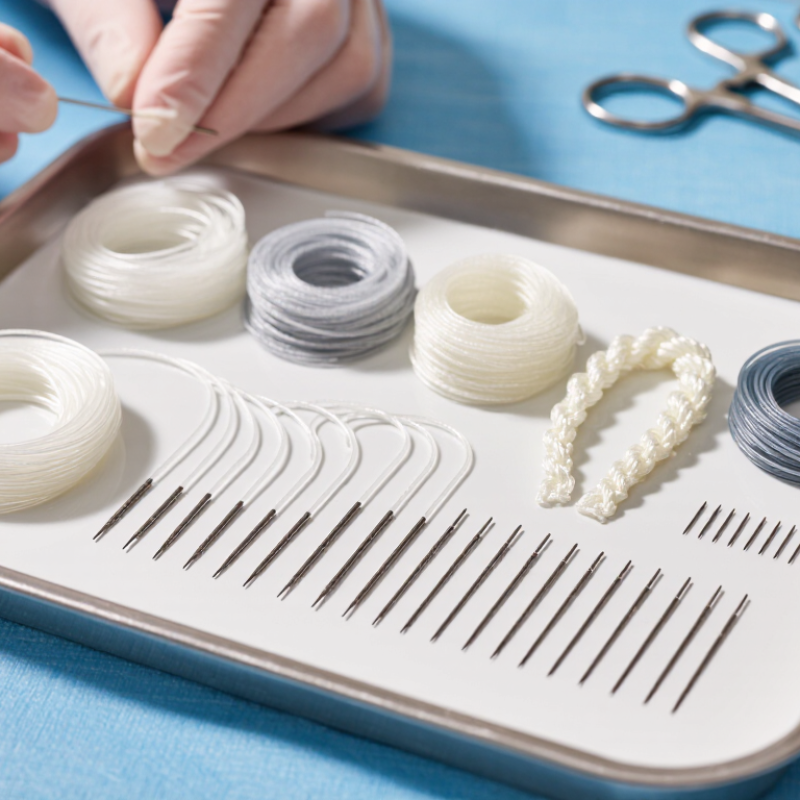
Non-Absorbable Sutures
Netlene · Polypropylene Netplast · Nylon / Polyamide Netsilk · Black Braided Silk Netbond · PolyesterEvery line is configurable by USP size, thread length, needle geometry and pack format — OEM and private-label programmes available.
Global buyers are paying closer attention to suture material, tissue response, and long-term handling. PTFE Sutures remain important in periodontal, cardiovascular, plastic, and general soft-tissue procedures. Their low tissue reactivity and nonabsorbable structure can support stable wound approximation when clinicians select them appropriately.
Market evidence supports continued interest. Grand View Research estimated the global surgical sutures market at approximately USD 4.4 billion in 2023, with steady growth projected through 2030. Fortune Business Insights also reported sustained expansion in its 2024 surgical sutures market analysis. These estimates differ because research firms use different product definitions and regional data. That difference deserves attention.
Clinical performance matters more than market size. The World Health Organization’s Global Guidelines for the Prevention of Surgical Site Infection emphasize appropriate material selection, aseptic technique, and disciplined wound management. The U.S. Food and Drug Administration classifies nonabsorbable sutures as regulated medical devices, requiring documented safety and performance controls. Buyers should therefore review sterilization validation, tensile strength, needle attachment, packaging integrity, and traceability before approval.
Not every PTFE product performs identically. Dense monofilament designs may glide smoothly, while expanded PTFE structures can offer a softer feel and different tissue interaction. Handling changes with diameter, needle geometry, coating, and knot configuration. Small details matter.
This guide compares leading PTFE Suture types for global purchasing teams in 2026. It considers clinical use, supplier documentation, quality systems, and regional logistics. Some specifications look impressive on paper. Real-world feedback may still reveal gaps. Careful evaluation remains essential.
PTFE sutures are surgical threads made from polytetrafluoroethylene, a fluoropolymer valued for chemical stability and low tissue reactivity. Their smooth surface can reduce tissue drag during placement. It feels soft.
Structure varies by design. Solid PTFE usually forms a smooth monofilament with consistent diameter and limited bacterial-harboring spaces. Expanded PTFE, or ePTFE, contains a controlled microporous structure. This design creates a softer, more pliable thread, although pore size and surface texture can affect handling, tissue interaction, and cleaning around exposed areas.
Core medical uses include cardiovascular repair, periodontal procedures, oral surgery, plastic surgery, and selected soft-tissue closures. Surgeons may choose PTFE when minimal tissue reaction and long-term strength are important. Its low memory can support precise knot placement, but the suture may feel different from conventional absorbable materials. The choice is not universal. Wound tension, contamination risk, anatomical location, and removal plans still matter. The details matter.
For global buyers, product evaluation should include diameter standards, needle attachment, sterilization method, tensile data, packaging integrity, and validated instructions for use. Regulatory clearance differs by market, so procurement teams should verify current documentation with qualified clinical and quality personnel. A common mistake is treating “PTFE” as one identical material. It is not. Small structural differences can change handling and clinical suitability. Selection should follow the intended procedure, surgeon preference, and applicable medical-device requirements.
A practical, brand-neutral comparison of commonly described PTFE suture configurations, material characteristics, and clinical applications.
| PTFE Suture Type / Configuration | Material and Structure | Absorbability | Key Functional Characteristics | Typical Medical Uses | Buyer Considerations |
|---|---|---|---|---|---|
| Expanded PTFE (ePTFE) monofilament | Expanded polytetrafluoroethylene with a microporous node-and-fibril structure; supplied as a single smooth strand. | Nonabsorbable | Low tissue reactivity, low surface friction, soft handling, and permanent tensile support. The microporous structure can differ by product specification. | Periodontal and oral soft-tissue closure, implant-related soft-tissue procedures, selected cardiovascular and plastic-surgery applications. | Review pore structure, strand diameter, knot-security data, needle quality, packaging, and intended anatomical use. |
| Microporous ePTFE suture | A highly expanded PTFE construction with interconnected micropores and a relatively soft, pliable strand. | Nonabsorbable | Designed to reduce tissue drag and support gentle approximation of delicate tissue; the porous architecture may influence handling and contamination-control requirements. | Dental and periodontal surgery, mucogingival procedures, soft-tissue graft stabilization, and selected reconstructive procedures. | Confirm the manufacturer’s validated pore and diameter specifications; do not assume that all ePTFE products have identical porosity. |
| Dense or low-expansion PTFE monofilament | PTFE with a comparatively compact structure and fewer or smaller voids than highly expanded ePTFE. | Nonabsorbable | Generally offers a firmer feel and low water absorption compared with more highly expanded structures; performance depends on formulation and processing. | Selected procedures requiring permanent monofilament support, including certain soft-tissue, cardiovascular, and reconstructive applications. | Compare flexibility, knot behavior, memory, tensile strength, and clinical indications rather than selecting solely by the “PTFE” label. |
| Fine-diameter PTFE suture | PTFE monofilament manufactured in smaller diameters, commonly selected where minimal tissue volume and precise placement are important. | Nonabsorbable | Useful for delicate approximation and improved cosmetic handling; smaller diameters generally provide less absolute tensile strength than larger diameters. | Periodontal microsurgery, ophthalmic soft-tissue work, facial or plastic-surgery closure, and other delicate tissue applications where indicated. | Check the exact USP diameter, needle profile, needle curvature, and suture-to-needle attachment strength. |
| Large-diameter PTFE suture | PTFE monofilament manufactured in larger diameters for applications requiring greater initial tensile support. | Nonabsorbable | Higher diameter can provide increased handling strength and load capacity, but may increase tissue passage resistance and local foreign-material volume. | Selected cardiovascular, reconstructive, tendon-support, and other procedures requiring durable permanent approximation, subject to clinical judgment. | Balance tensile requirements against tissue trauma, knot profile, needle penetration, and the risk of excessive tension. |
| Needle-attached PTFE suture | PTFE strand factory-attached to a surgical needle; needle options may include taper, cutting, reverse-cutting, or other profiles depending on the indication. | Nonabsorbable | Provides a ready-to-use sterile system and may improve consistency of needle penetration and suture delivery. | Common across dental, cardiovascular, ophthalmic, plastic, reconstructive, and general soft-tissue procedures where PTFE is clinically appropriate. | Evaluate needle geometry, curvature, diameter, attachment integrity, sterile barrier, shelf life, and local regulatory requirements. |
| PTFE suture for dental and periodontal use | Usually a soft, monofilament PTFE configuration selected for low tissue interaction and manageable handling around oral tissues. | Nonabsorbable | Can support atraumatic tissue approximation and is often selected when predictable removal and low plaque-retentive surface characteristics are desired. | Periodontal flap closure, guided tissue or bone regeneration procedures, implant-site soft-tissue management, and oral mucosal closure. | Confirm oral-surgery indication, needle design, strand diameter, knot security, removal protocol, and compatibility with the intended membrane or graft procedure. |
| PTFE suture for cardiovascular or reconstructive use | Permanent PTFE monofilament selected for durable approximation or fixation where long-term mechanical support may be required. | Nonabsorbable | Provides permanent tensile support and low biodegradation; clinical performance depends on suture design, tissue environment, implantation technique, and sterilization. | Selected cardiovascular, vascular-access, reconstructive, and plastic-surgery procedures when specified by the surgical technique and applicable instructions for use. | Require procedure-specific validation, biocompatibility documentation, sterilization records, tensile-performance data, and regulatory clearance for the target market. |

Technical note: PTFE sutures are generally permanent, nonabsorbable synthetic monofilaments. “ePTFE,” pore size, diameter, needle type, tensile performance, sterilization method, and approved indications vary by product and jurisdiction. Final selection should follow the surgeon’s technique, the applicable instructions for use, and local medical-device regulations.
In 2026, global buyers can find two main PTFE suture types: expanded PTFE and solid PTFE monofilament. Expanded PTFE has a soft, porous structure and a larger feel during handling. Surgeons may prefer it where gentle tissue contact and secure knot placement matter. Solid PTFE offers a smoother surface and consistent diameter. It can support procedures requiring low surface interaction and predictable passage. Neither type fits every surgical field.
Buyers should compare USP size, tensile strength, needle design, suture length, sterilization method, and package integrity. ePTFE products may feel more pliable, but their porous structure requires careful handling. Solid PTFE may slide smoothly, yet knot security still depends on technique and configuration. Product data should include lot traceability, shelf life, instructions for use, and quality certificates. Regulatory acceptance also differs by market. A familiar specification is not automatically a universal approval.
Tips: Request samples for simulated handling before placing large orders. Check the suture after needle attachment, knot tying, and gentle tension. Ask whether the supplier can provide consistent documentation across lots. Do not judge only by price. In my experience, catalog descriptions can hide small but important differences. Recheck them.
Key PTFE Suture Types Available to Global Buyers in 2026
A synthetic, nonabsorbable single-filament format commonly specified where low tissue reactivity and smooth passage are priorities.
A soft, microporous PTFE format used in selected soft-tissue and cardiovascular procedures, subject to local regulatory clearance.
The chart shows indicative diameter bands for commonly specified USP size classes. Actual size availability, construction, needle configuration, sterilization method, and regulatory status vary by supplier and destination market. PTFE sutures are nonabsorbable synthetic sutures.
For global buyers, PTFE suture comparison starts with the material, not the catalog photograph. Expanded PTFE offers a microporous structure and soft tissue handling. Dense PTFE feels smoother and may resist fluid absorption more effectively. Neither option fits every procedure. Review tensile retention, elongation, knot security, surface texture, and sterilization records. Grand View Research reported that the global surgical sutures market could grow at about 5.9% annually from 2024 to 2030, increasing pressure on purchasers to verify technical claims.
Size needs careful checking. USP 2-0, 3-0, and 4-0 describe diameter ranges, not identical performance across suppliers. A procurement team should request diameter tolerances, straight-pull strength, and knot-pull results from controlled testing. ISO 10993 biological evaluation records can support material safety review, but they do not replace procedure-specific assessment. Small details matter. A slippery 4-0 strand may need a different knot technique than a textured 4-0 strand.
Needle design changes handling at the tissue interface. Reverse-cutting needles can improve penetration through dense tissue, while taper needles may reduce cutting action in softer tissue. Compare needle length, curvature, point geometry, attachment strength, and needle-to-suture ratio. The World Health Organization’s Global Surgery report has highlighted the continuing need for reliable surgical systems in resource-limited settings, making packaging integrity and clear instructions especially important. My practical concern is simple: buyers sometimes compare price per box, then discover different needle counts or unusable lengths. That comparison is incomplete. Request samples, inspect memory after opening, and record performance under real handling conditions.
PTFE sutures are valued for smooth handling, low tissue reactivity, and strong knot performance. Monofilament PTFE may reduce fluid absorption and bacterial sheltering. Expanded PTFE offers a softer structure and improved flexibility in selected procedures. Clinical suitability still depends on tissue type, wound tension, needle design, and surgeon preference. A thicker suture is not automatically safer. Buyers should review tensile strength, knot security, elongation, and handling feedback from real clinical settings.
Tips: Request samples from each production lot. Check needle attachment under magnification. Review sterilization records, shelf-life data, and package integrity. Confirm that the instructions for use match the intended market. Regulatory requirements differ across countries, so verify device classification, registration duties, labeling language, and import documents before purchase. ISO 13485 certification supports quality management, while biocompatibility and sterilization evidence should fit the finished device.
Quality problems can appear after shipment. Packaging may weaken during humidity changes, rough handling, or long storage. Ask for lot traceability, certificates of analysis, nonconformance procedures, and stability evidence. An on-site or remote supplier audit can reveal gaps that documents miss. Yet no checklist is perfect. A low price may hide limited technical support or inconsistent needle bonding. International buyers should compare total risk, not only unit cost. Product records should remain clear, current, and easy to verify.
PTFE sutures are valued for low tissue reactivity, smooth passage, and reliable long-term support. Their nonabsorbable structure suits procedures requiring stable wound closure. Common options include solid monofilament PTFE and expanded PTFE with a microporous structure. Each design handles differently under tension.
In surgical applications, buyers should match suture diameter with tissue strength and healing time. Cardiovascular and soft-tissue procedures may require strong, low-drag material with dependable knot security. Dental users often prefer smooth handling for periodontal, implant, and graft procedures. Needle shape matters too. A sharp, reverse-cutting needle may suit dense gingiva, while a finer needle can reduce tissue trauma. Small details affect comfort.
Tips: Check tensile strength, elongation, needle geometry, sterilization records, and package integrity. Request technical data and independent quality documentation. Confirm storage conditions before purchase. A low-friction surface may reduce drag, but it can also require careful knot technique. Practice matters. No single PTFE type wins every case. Clinical preference is useful, yet it should not replace procedure-specific evaluation. Global buyers should also review applicable regulatory documentation and local procurement requirements. Some product descriptions sound similar, but performance can differ significantly. That deserves a closer look.
Common options include solid monofilament PTFE and expanded PTFE. Monofilament material usually absorbs less fluid. Expanded PTFE feels softer and more flexible. Neither type suits every procedure.
Match diameter with tissue strength, wound tension, and expected healing time. A thicker suture is not automatically safer. Excess material may affect handling and tissue comfort. Procedure-specific evaluation remains important.
Needle shape affects passage, tissue trauma, and control. A reverse-cutting needle may suit dense gingiva. A finer needle can reduce tissue disruption. Small details matter.
Request tensile strength, elongation, knot security, and handling data. Ask for sterilization records and shelf-life evidence. Inspect needle attachment under magnification. A sample from each production lot is useful.
Review package integrity, storage conditions, and stability evidence. Humidity changes can weaken packaging. Rough handling and long storage may create hidden damage. Examine the package carefully.
Verify device classification, registration duties, labeling language, and import documents. Confirm that instructions match the intended market. Quality certification supports production controls. It does not replace finished-device evidence.
Ask for lot traceability, certificates of analysis, and nonconformance procedures. Conduct a remote or on-site audit when practical. Documents can look complete while technical support remains limited. That deserves a closer look.
Not necessarily. Compare needle bonding, consistency, technical support, and shipment risks. A low price may hide uneven quality. Total risk matters more than unit cost.
PTFE Sutures are specialized surgical materials valued for their smooth surface, low tissue reactivity, and reliable strength. In 2026, global buyers can choose from monofilament and expanded PTFE options, with variations in diameter, flexibility, coating, and needle configuration. These sutures support a range of surgical and dental procedures where secure tissue approximation, reduced drag, and long-term stability are important.
When comparing PTFE Sutures, purchasers should assess material structure, suture size, tensile performance, handling characteristics, and needle design according to the intended application. International purchasing decisions should also consider sterility assurance, packaging integrity, traceability, product consistency, regulatory documentation, and quality-control procedures. Selecting the right combination of suture and needle can improve placement efficiency and procedural outcomes. By aligning clinical requirements with verified specifications and dependable supply capabilities, hospitals, clinics, and distributors can make informed choices for surgical and dental use.