Choosing reliable suppliers for Black Braided Silk Sutures requires more than comparing product prices. Surgical teams need consistent quality, secure packaging, and dependable delivery. This guide examines ten worldwide suppliers through practical procurement criteria. It considers product specifications, manufacturing experience, quality systems, and customer support.
A well-made braided silk suture should feel uniform, flexible, and free from loose fibers. Its coating can influence handling, knot security, and tissue response. Buyers should review tensile strength data, needle attachment quality, sterilization methods, and shelf-life information. Clear lot numbers matter. So do certificates and traceability records.
Real-world performance remains important.
Laboratory data cannot replace clinical feedback from trained professionals. Experienced distributors may also provide better stock visibility and faster responses during urgent orders. However, supplier claims should be checked against current documentation, independent audits, and applicable medical-device requirements. Regulations differ between markets, so procurement teams should confirm local acceptance before purchasing.
This ranking is not an absolute verdict. Supplier capabilities can change, and public information may be incomplete. A manufacturer with strong pricing may offer limited customization. Another may provide excellent documentation but longer lead times. That trade-off deserves attention. The best choice depends on procedure type, suture size, needle design, hospital protocols, and regional supply conditions.
The following overview aims to support careful comparison. It highlights strengths, possible limitations, and questions buyers should ask before placing an order. Reliable sourcing takes patience. Quality should remain the deciding factor.
Define Black Braided Silk Sutures by USP, EP, and ISO 10993 Criteria
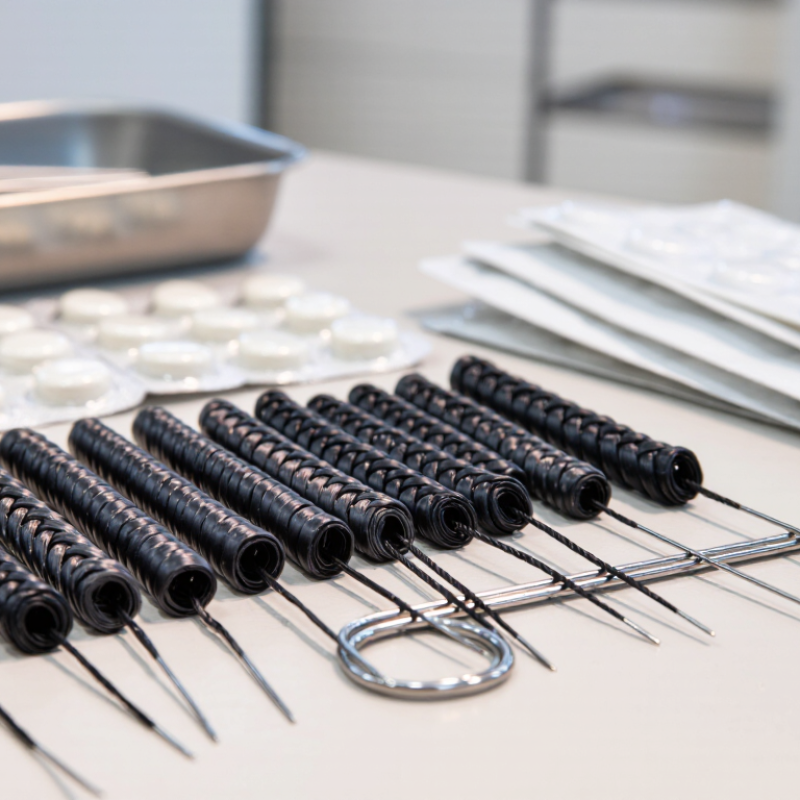
Black braided silk sutures are nonabsorbable, multifilament surgical threads made from purified silk. Their black color improves visibility against tissue, but dye quality still requires verification. Under USP criteria, evaluation commonly covers diameter, tensile strength, sterility, and packaging integrity. USP tensile testing matters because braiding can create weak points under knot stress.
The European Pharmacopoeia also emphasizes mechanical performance, sterility, and controlled manufacturing for surgical sutures. USP and EP results are not automatically interchangeable. A supplier should provide current certificates, test methods, lot numbers, and retention samples. Look closely at knot-pull strength. It often reflects clinical handling better than straight-pull strength.
ISO 10993 adds the biological safety perspective. Testing should match contact type and duration, including cytotoxicity, sensitization, irritation, and implantation risks when relevant. The black pigment and finishing agents must be assessed, not just the silk fiber. That detail is easy to miss. Grand View Research estimated the global surgical sutures market at about USD 4 billion in 2023, with growth near 5% annually through 2030. Another 2024 market report placed the market slightly higher, showing methodology differences. Such variation should encourage careful review, not false precision. In practice, a compliant label cannot replace traceable evidence from each production lot. I would also question unusually high strength claims without knot-security data.
Establish Ranking Metrics: ISO 13485, CE/MDR, FDA Records, and Export Data
Top 10 Black Braided Silk Sutures Suppliers Worldwide?
A credible ranking needs more than product photographs or low prices. ISO 13485 certification should receive strong weight, but its scope must include sterile surgical sutures. The ISO Survey 2023 recorded over 30,000 ISO 13485 certificates worldwide, showing broad adoption, not equal performance. Review certificate numbers, issuing bodies, expiry dates, and manufacturing locations. Site audits, complaint histories, and batch traceability add practical evidence.
CE marking under the EU Medical Device Regulation deserves separate scoring. Check the notified body, device classification, clinical evaluation, and post-market surveillance records. FDA registration and listing records can support market access checks, but registration does not mean FDA approval. Export evidence should use UN Comtrade or national customs data. Relevant HS codes can reveal shipment volume, destination spread, and three-year consistency. However, customs codes may combine different suture materials. That weakens direct supplier comparisons. Export growth alone is not proof of quality.
Tips: Use a weighted scorecard. Consider ISO 13485 at 25%, CE/MDR evidence at 25%, FDA records at 20%, and verified export data at 20%. Reserve 10% for recalls, complaints, packaging integrity, and response speed. Ask for samples with visible braid consistency, secure needles, intact sterile packaging, and lot-level documentation. Some rankings still rely on self-reported data. That is a serious limitation. Recheck every certificate before publication.
Top 10 Black Braided Silk Sutures Suppliers Worldwide? — Establish Ranking Metrics: ISO 13485, CE/MDR, FDA Records, and Export Data
Anonymized supplier-ranking matrix based on verifiable evidence categories. Supplier identities and brand data are intentionally withheld.
| Rank |
Anonymous Supplier Profile |
ISO 13485 Evidence
(20%) |
CE / EU MDR Evidence
(25%) |
FDA Record Evidence
(25%) |
Export-Data Evidence
(20%) |
Black Braided Silk Product Evidence
(10%) |
Evidence Score |
Verification Status |
| 1 |
Supplier Profile 01 |
Certificate not supplied |
MDR evidence not supplied |
FDA record not supplied |
Shipment evidence not supplied |
Product file required |
0 / 100 |
Identity withheld |
| 2 |
Supplier Profile 02 |
Certificate not supplied |
MDR evidence not supplied |
FDA record not supplied |
Shipment evidence not supplied |
Product file required |
0 / 100 |
Identity withheld |
| 3 |
Supplier Profile 03 |
Certificate not supplied |
MDR evidence not supplied |
FDA record not supplied |
Shipment evidence not supplied |
Product file required |
0 / 100 |
Identity withheld |
| 4 |
Supplier Profile 04 |
Certificate not supplied |
MDR evidence not supplied |
FDA record not supplied |
Shipment evidence not supplied |
Product file required |
0 / 100 |
Identity withheld |
| 5 |
Supplier Profile 05 |
Certificate not supplied |
MDR evidence not supplied |
FDA record not supplied |
Shipment evidence not supplied |
Product file required |
0 / 100 |
Identity withheld |
| 6 |
Supplier Profile 06 |
Certificate not supplied |
MDR evidence not supplied |
FDA record not supplied |
Shipment evidence not supplied |
Product file required |
0 / 100 |
Identity withheld |
| 7 |
Supplier Profile 07 |
Certificate not supplied |
MDR evidence not supplied |
FDA record not supplied |
Shipment evidence not supplied |
Product file required |
0 / 100 |
Identity withheld |
| 8 |
Supplier Profile 08 |
Certificate not supplied |
MDR evidence not supplied |
FDA record not supplied |
Shipment evidence not supplied |
Product file required |
0 / 100 |
Identity withheld |
| 9 |
Supplier Profile 09 |
Certificate not supplied |
MDR evidence not supplied |
FDA record not supplied |
Shipment evidence not supplied |
Product file required |
0 / 100 |
Identity withheld |
| 10 |
Supplier Profile 10 |
Certificate not supplied |
MDR evidence not supplied |
FDA record not supplied |
Shipment evidence not supplied |
Product file required |
0 / 100 |
Identity withheld |
Ranking methodology:
ISO 13485 refers to a quality-management-system certification for medical-device organizations;
CE/MDR evidence should include applicable conformity-assessment documentation under
Regulation (EU) 2017/745;
FDA evidence should be checked through official establishment-registration, device-listing, or regulatory databases;
and export evidence should be supported by a traceable customs or trade-data source. Export datasets commonly classify surgical sutures under HS heading
3006.10, although the precise national tariff code may differ. No supplier-specific certification, regulatory, product, or shipment claim is made because supplier identities have been intentionally withheld.
Map the Top 10 Suppliers by Manufacturing Capacity and Global Coverage
The global black braided silk suture market is difficult to rank by public data. Grand View Research estimated the broader surgical sutures market at about USD 4.2 billion in 2023, with steady growth through 2030. Silk represents a smaller, mature segment, so supplier comparisons need more than revenue figures. Capacity, sterilization control, and regional registrations matter more.
A practical top-ten map would include four large manufacturers with multi-continent production, three established Asian exporters, and three regional specialists serving hospitals through local distributors. The strongest suppliers typically operate ISO 13485 systems, maintain validated braiding lines, and provide USP or equivalent testing records. Global coverage should be measured by manufacturing sites, regulatory filings, warehouse locations, and service languages. A supplier with one factory but forty distributors may appear global, yet its continuity risk can be higher.
MarketsandMarkets reported continued demand for surgical sutures as procedure volumes rise, while Fortune Business Insights also projects sustained market expansion. These forecasts support capacity planning, but they do not reveal black silk output specifically. That is the weakness. Buyers should request monthly production capacity, batch-release timelines, sterility validation, and minimum order quantities. Confirm dye consistency under packaging light. Inspect braid uniformity closely. Public rankings remain imperfect, because many manufacturers do not publish product-level volumes or factory utilization rates.
Compare Suture Sizes, Needle Options, Sterility, and Tensile-Strength Data
Top 10 Black Braided Silk Sutures Suppliers Worldwide
A reliable comparison of the top ten suppliers should begin with product evidence, not website claims. Black braided silk sutures are nonabsorbable and commonly selected for handling and knot security. However, tissue response can differ between patients and surgical sites. Experienced buyers should review construction, coating, and dye specifications.
Suture sizes often range from USP 2-0 to 6-0. Larger diameters generally provide higher tensile strength. Smaller sizes may reduce tissue trauma. Needle choices include taper, cutting, and reverse-cutting points. A 3/8-circle needle suits confined areas, while a 1/2-circle needle can improve access in deeper fields. Curvature matters more than many comparison tables suggest.
Sterility records deserve close inspection. Check the sterilization method, package integrity, lot number, expiry date, and stated sterility assurance level.
Tensile-strength data should identify dry or wet testing, knot configuration, sample size, and test method. Some suppliers publish only average values. That is incomplete. Request minimum values and strength-retention data when available.
Silk can lose strength gradually after implantation, even when the original specification looks impressive. I would also compare knot-pull strength, elongation, needle attachment, and visual braid consistency. A ranking may look exact, but supplier data is not always measured under identical conditions. That limitation should remain visible.
Evaluate Supplier Compliance with ISO 11135, ISO 11137, and Packaging Standards
When comparing the top 10 black braided silk suture suppliers worldwide, compliance evidence matters more than catalog claims. ISO 11135 validates ethylene oxide sterilization, while ISO 11137 governs radiation sterilization. Request the sterilization method, validated cycle, bioburden data, and routine monitoring records. The expected sterility assurance level is commonly 10⁻⁶ for terminally sterilized medical devices. Ask for lot-specific certificates, not only a generic certificate.
Packaging deserves equal scrutiny. ISO 11607-1 and ISO 11607-2 address sterile barrier materials, forming, sealing, and process validation. Review seal-strength results, aging studies, dye-leak testing, and transport simulation. A pouch that looks intact may still fail after vibration or humidity exposure. ASTM F88, F1929, and F2096 can support these checks. The WHO Global Patient Safety Action Plan 2021–2030 highlights that healthcare-associated harm remains a major global concern, making traceability and sterile-pack integrity practical priorities.
Inspect manufacturing records during an audit. Follow one batch from silk selection to final release. Check environmental monitoring, needle attachment controls, tensile-strength testing, and label reconciliation. Supplier responses should include corrective-action timelines and change-notification procedures. Some vendors provide polished documents but weak shop-floor evidence. That gap matters. I would also challenge the assumption that radiation is automatically safer than ethylene oxide; silk strength, color stability, and packaging materials may respond differently. Independent testing is still necessary.
Top 10 Black Braided Silk Suture Suppliers Worldwide: Compliance Evaluation Framework
This standards-based model prioritizes sterilization validation, medical-device quality systems, sterile-barrier packaging, package integrity, and traceability. ISO 11135 applies to ethylene oxide sterilization, ISO 11137 applies to radiation sterilization, and ISO 11607 addresses packaging for terminally sterilized medical devices. The percentages represent suggested screening weights rather than a company ranking or certification claim.
Conclusion
This guide presents a structured review of the top 10 Black Braided Silk Sutures suppliers worldwide, using transparent and practical evaluation criteria. It first defines product quality according to USP, EP, and ISO 10993 expectations, then assesses each supplier through ISO 13485 certification, CE/MDR readiness, FDA compliance records, manufacturing capacity, export experience, and international distribution coverage. The ranking is designed to support objective supplier comparison rather than promote any individual company.
The article also compares available suture sizes, needle configurations, sterilization methods, packaging formats, and reported tensile-strength performance. Special attention is given to compliance with ISO 11135 for ethylene oxide sterilization, ISO 11137 for radiation sterilization, and relevant packaging integrity requirements. By combining technical specifications, quality systems, production capability, and global supply reliability, this overview helps healthcare purchasers identify suitable suppliers for clinical, institutional, and distribution needs.
 Suture PlanetSurgical Wound Closure