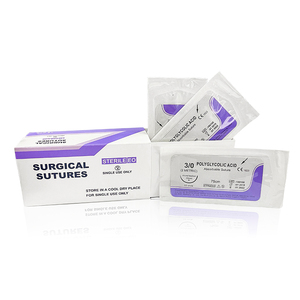
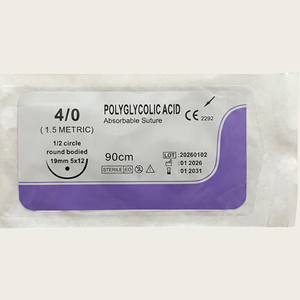
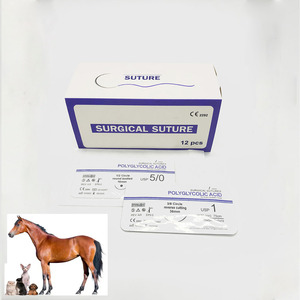
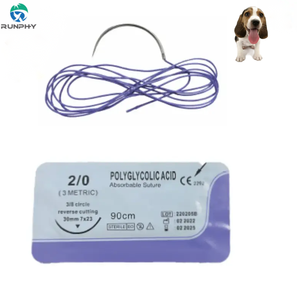
High-tensile strength, sterile absorbable sutures engineered under audited WHO-GMP cleanroom environments for veterinary, mucosal, and general surgical closure.
Plain Catgut remains one of the most historically significant and chemically unique absorbable sutures in biological surgery. Sourced from the purified collagenous submucosa of bovine (cattle) intestine or the serosal layer of ovine (sheep) intestine, Plain Catgut offers rapid enzymatic degradation coupled with high initial tensile strength.
Unlike synthetic absorbable sutures (such as PGA or PGLA 910) which undergo hydrolytic cleavage via water molecules, Plain Catgut is broken down inside body tissues through an enzymatic reaction driven by endogenous proteases and active macrophage phagocytosis. This property makes Plain Catgut uniquely suitable for rapidly healing mucosal tissues, gastrointestinal tract apposition, gynaecological procedures, and veterinary surgeries where long-term foreign body presence is undesirable.
As a leading CE certified plain catgut factory, our facility adheres to strict raw material isolation standards. Each batch of biological ribbon is subject to rigorous alkaline washing, enzymatic lipid extraction, electronic tension spinning, centerless precision grinding, and alcohol-fluid conditioning to guarantee uniform strand diameter compliant with USP and European Pharmacopoeia (EP) monograph standards.

98%+ natural purified structural collagen strands treated without heavy metal tanning agents.
Retains ~50% of initial strength at 7 to 10 days post-implantation; drops to 0% by day 14 to 21.
Full tissue absorption achieved within 60 to 70 days via natural enzymatic proteolytic breakdown.
Ethylene Oxide (EO) validated to ISO 11135, maintaining SAL 10⁻⁶ without thermal degradation.
Navigating international biological device registrations requires rigorous proof of viral inactivation, BSE/TSE risk elimination, and full chain-of-custody documentation.
Under EU Regulation 722/2012 for medical devices utilizing tissue of animal origin, our Plain Catgut factories source exclusively from EDQM-certified herds in BSE-free geographical zones. Every batch is supported by an active Certificate of Suitability (CEP).
From ribbon slitting to final needle swaging and sterile pouching, every step runs inside our unified plant. Complete device history records (DHR) link raw polymer/collagen lots directly to sterilizer pressure charts and release COAs.
Comprehensive biological evaluation reports include cytotoxicity, systemic toxicity, intracutaneous reactivity, sensitisation, and pyrogenicity testing (LAL assays retaining endotoxin levels well below < 20 EU/device).
Analysis of shifting global demand, regulatory tightening, and digital supply chain integration for hospital systems and medical distributors over the next decade.
Global health authorities (US FDA, EU EUDAMED, Saudi SFDA) are enforcing mandatory Unique Device Identification (UDI) in 2D DataMatrix and GS1 barcode formats. Modern suture procurement requires factories capable of printing direct UDI payload data on primary foil packs and outer cartons for automated hospital inventory tracking.
Distributors and tender procurement agents are moving away from fragmented supply chains. Partnering with unified OEM factories that execute ribbon extraction, needle manufacturing, laser drilling, swaging, and sterilisation under one roof reduces audit complexity and guarantees batch-to-batch consistency.
While synthetic absorbables (PGA, PGLA 910) dominate elective human surgery, natural Plain and Chromic Catgut continue to see robust growth in veterinary medicine, dental surgery, mucosal closure, and low-resource healthcare infrastructure due to superior tissue handling, pliability, and fast enzymatic breakdown.
Future packaging trends emphasize hermetically sealed dual-aluminium foil pouches with isopropyl alcohol preservation fluid for catgut strands, ensuring zero moisture degradation during long-distance oceanic transits while minimizing packaging waste.
From micro-laser drilling of 300-series stainless steel needles to electronic diameter gauging, state-of-the-art suture production eliminates historical hand-crafting defects.
Traditional drilled or channel needles have been upgraded to 3D laser-drilled blind holes in AISI 420 and AISI 302 stainless steel alloys. This creates a seamless transition between needle and thread, reducing tissue drag and insertion force.
Continuous laser optical micrometers measure collagen strand diameter during centerless grinding. This guarantees strict compliance with USP knot-pull and tensile limits across sizes USP 6-0 through USP 3.
Plain Catgut strands are packed in conditioned isopropyl alcohol / water solution sachets to maintain natural collagen hydration, flexibility, and anti-memory handling characteristics without sacrificing sterile barrier integrity.
Comprehensive laboratory and pharmacopoeial performance data comparing Plain Catgut with Chromic Catgut and Synthetic Absorbable Materials (PGA, PGLA 910, PDO, Poliglecaprone 25).
| Material Family | Polymer / Source | Structure | Tensile Retention (In-Vivo) | Mass Absorption | Tissue Reaction Score | Primary Clinical Indications |
|---|---|---|---|---|---|---|
| Plain Catgut | Purified Bovine/Ovine Collagen | Twisted Strand / Polished | 50% @ 7–10 Days | 60–70 Days (Enzymatic) | Moderate (Biological) | Mucosa, GI tract, Gynaecology, Vet Surgery |
| Chromic Catgut | Chromium-Tanned Collagen | Twisted Strand / Tanned | 50% @ 14–21 Days | 90 Days (Enzymatic) | Moderate / Low | General Closure, Ophthalmic, Ligation |
| PGA (Netsorb) | Polyglycolic Acid | Braided & Coated | 75% @ 14d, 50% @ 21d | 60–90 Days (Hydrolytic) | Very Low (Synthetic) | General Soft Tissue, Orthopaedics, Subcuticular |
| PGLA 910 (Netcryl) | Polyglactin 910 (90/10) | Braided & Coated | 75% @ 14d, 50% @ 21d | 56–70 Days (Hydrolytic) | Very Low (Synthetic) | General Surgery, OB/GYN, Dental, Urology |
| PDO / PDS (Netsynth) | Polydioxanone | Monofilament | 70% @ 14d, 50% @ 28d | 180–210 Days (Hydrolytic) | Minimal | Fascial Closure, Abdominal Wall, Paediatric CV |
| Poliglecaprone 25 | Poly(glycolide-co-caprolactone) | Monofilament | 50–60% @ 7d, 20–30% @ 14d | 91–119 Days (Hydrolytic) | Minimal | Plastic Surgery, Subcuticular Skin Closure |
* Data derived from standard USP 43 / EP 10.0 laboratory monographs and in-vivo animal bio-absorption testing protocol audits.
We empower regional distributors, medical device brand owners, and public tender agents to build proprietary surgical lines with comprehensive regulatory backing.
Our state-of-the-art manufacturing campus in Bengaluru, Karnataka, India operates under strict ISO 13485:2016 and WHO-GMP certifications. By controlling every phase of production in-house, we eliminate external supplier delays and quality variances.
Every single batch of surgical sutures undergoes exhaustive internal testing prior to quality release:
100% verified swage pull-out resistance testing per USP limits.
Electronic multi-axis laser micrometer verification across every meter of thread.
Bubble emission and dye penetration testing according to ASTM F1929 standards.
Direct technical and commercial answers for hospital purchasing committees, regulatory officers, and import agents.
Request free sample kits, technical registration dossiers, or factory-direct B2B quotation pricing from our global export desk.