Executive Technical Summary: Sourcing Absorbable Sutures from China
The global demand for high-grade bio-absorbable surgical sutures has undergone a structural shift. Hospital procurement desks, OEM distributors, and veterinary surgical supply networks increasingly prioritize China’s advanced medical device manufacturing infrastructure. Modern Chinese suture production hubs have evolved far beyond basic assembly; they now feature state-of-the-art cleanroom polymer extrusion, precision micro-braiding, automated laser drilling, micro-swaging, and validated Ethylene Oxide (EO) sterilization chambers.
Selecting premier China absorbable sutures manufacturers requires a technical evaluation of polymer degradation kinetics, tensile strength retention profiles, needle attachment security, and regulatory dossier completeness. This technical guide outlines the engineering specifications, chemical compositions, procurement trends, and regulatory frameworks required to audit OEM factories and establish direct manufacturing partnerships.
Information Gain Key Takeaway: Unlike legacy non-absorbable materials (e.g., standard silk or nylon), absorbable sutures require strict control over hydrolytic bio-degradation. Top-tier Chinese factories utilize automated gravimetric polymer dosing and inline laser micrometers to maintain filament diameter tolerances well within USP (United States Pharmacopeia) and EP (European Pharmacopoeia) strict limits.
Polymer Chemistry & Material Science Comparison
Absorbable sutures are broadly classified into synthetic bio-polymers and natural organic collagen derivatives. Understanding their in-vivo behavior is critical for surgical specialty matching and tender specification writing.
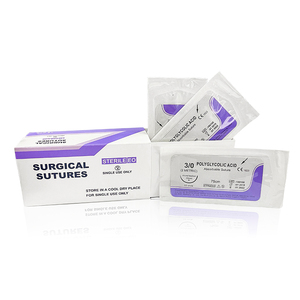
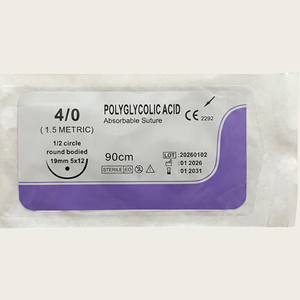
Composed of 100% homopolymerized glycolic acid, PGA sutures (such as our Netsorb series) feature a precision micro-braided structure coated with polycaprolactone and calcium stearate. PGA undergoes predictable hydrolysis, breaking down into glycolic acid monomers absorbed naturally by tissue metabolisms.
In-Vivo Tensile Retention: Maintains approximately 65-70% original breaking load strength at 14 days post-implantation; ~35% at 21 days.
Complete Absorption: Hydrolytic dissolution completed within 60 to 90 days.
Primary Applications: General soft tissue closure, gastrointestinal surgery, gynaecology, and veterinary procedures.
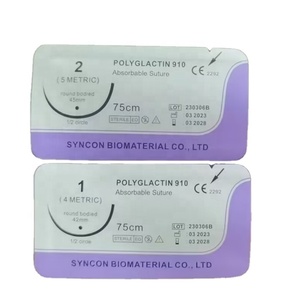
PGLA 910 consists of a copolymer synthesized from 90% glycolide and 10% L-lactide. The incorporation of hydrophobic lactide monomers provides a smoother knot run-down and slightly modified absorption curve compared to pure PGA.
In-Vivo Tensile Retention: Retains ~75% breaking strength at 14 days, ~50% at 21 days, and ~25% at 28 days.
Complete Absorption: Bio-absorption is finalized via enzymatic and hydrolytic paths within 56 to 70 days.
Primary Applications: Ophthalmic microsurgery (in fine USP sizes 8-0 to 10-0), pediatric surgery, skin subcuticular closure, and animal surgeries.
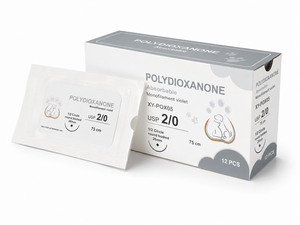
Synthesized from the polyester poly(p-dioxanone), PDO monofilament sutures represent the gold standard for long-term critical tissue support. The monofilament structure exhibits minimal bacterial nidus accumulation and low tissue drag.
In-Vivo Tensile Retention: High initial strength; retains ~70% at 14 days, ~50% at 28 days, and ~25% at 42 days.
Complete Absorption: Minimal tissue reaction with complete degradation between 180 and 210 days.
Primary Applications: Abdominal wall closure, fascia repair, orthopedics, and pediatric cardiovascular anastomoses.
A copolymer of glycolide and epsilon-caprolactone, PGCL monofilament offers exceptional pliability and handling without memory, making it ideal for cosmetic skin closure.
In-Vivo Tensile Retention: ~50-60% strength retained at 7 days; ~20-30% at 14 days.
Complete Absorption: Hydrolytically absorbed in 91 to 119 days.
Derived from clean bovine intestinal serosa or ovine submucosa, Catgut is treated with chromic salt solutions to retard enzymatic digestion by lysosomal enzymes.
Material Family
Structure
Tensile Retention (14 Days)
Absorption Period
Tissue Reactivity
Primary Surgical Indications
PGA (Polyglycolic Acid)
Braided & Coated
65% – 70%
60 – 90 Days
Very Low
General Surgery, Gynaecology, Vet
Polyglactin 910 (PGLA)
Braided & Coated
75%
56 – 70 Days
Minimal
General, Ophthalmic, Subcuticular
Polydioxanone (PDO/PDS)
Monofilament
70%
180 – 210 Days
Extremely Low
Fascia, Orthopedics, Abdominal Wall
Poliglecaprone 25 (PGCL)
Monofilament
20% – 30%
91 – 119 Days
Minimal
Plastics, Subcuticular Skin Closure
Chromic Catgut
Twisted Strand
Variable (Lost rapidly)
~90 Days
Moderate (Enzymatic)
Veterinary, Dental, Rapid Mucosa
China Factory Capabilities: Single-Site Chain of Custody
Leading Chinese suture manufacturers distinguish themselves through integrated single-site chain of custody. By avoiding outsourced processing, leading factories maintain total quality control over every critical production stage:
1. Cleanroom Extrusion & Braiding
Medical-grade polymer granules are processed in ISO Class 7 cleanrooms using multi-cavity precision extruders. Automated braiding machinery controls tension to ensure optimal knot security and zero fraying during surgical knot tying.
2. Laser Drilling & Swaging
Automated laser drilling machines drill precision channels in 300-series and 400-series stainless steel needles. High-speed CNC micro-swaging preserves needle-to-thread attachment pull-out force well above USP monograph standards.
3. EO Sterilization & Packaging
Hermetically sealed in moisture-proof primary aluminum foil packs, suture sets undergo validated Ethylene Oxide (EO) cycles achieving a Sterility Assurance Level (SAL) of 10⁻⁶ with EO residuals monitored per ISO 10993-7.
Global Procurement Trends & Future Development in Suture Manufacturing
As international healthcare standards tighten under the European Union Medical Device Regulation (EU MDR 2017/745) and US FDA requirements, the procurement strategy for absorbable sutures is rapidly changing. Key industry dynamics shaping factory output include:
Trend A: Antimicrobial Coated Absorbable Sutures
Surgical Site Infections (SSIs) represent a significant cost burden for hospital networks. Chinese factories are scaling up production of Triclosan-coated PGA and PGLA 910 sutures. The antimicrobial agent creates a zone of inhibition around the wound bed, preventing colonization by Staphylococcus aureus, Staphylococcus epidermidis, and MRSA strains without compromising tensile strength degradation profiles.
Trend B: Knotless Barbed Suture Platforms
Bi-directional and uni-directional barbed polydioxanone and polyglycolic sutures eliminate the need for manual knot tying in laparoscopic, robotic, and minimally invasive surgeries. Microscopic barbs engineered into the suture body distribute tension evenly along the wound line, accelerating closure time by up to 35%.
Global regulatory agencies mandate full traceability down to single primary foil envelopes. Premier Chinese OEM suppliers provide 2D DataMatrix Unique Device Identification (UDI) compliance, allowing seamless integration into hospital inventory systems across Europe, North America, and LATAM markets.
Trend D: Sustainable Bio-Polymer Synthesis
Future development focuses on green chemistry polymer synthesis. Factories are introducing bio-based glycolide monomer sources to reduce carbon footprints while guaranteeing identical hydrolytic degradation timelines and shelf-life stability.
Procurement FAQ: Sourcing Absorbable Sutures from China
Answers to standard operational, regulatory, and quality control questions raised by procurement managers, tender agencies, and medical device importers.
Q1: How do top Chinese factories guarantee the shelf life of absorbable sutures?
Absorbable synthetic polymers like PGA and PGLA hydrolyze when exposed to atmospheric moisture. Leading Chinese facilities utilize automated primary packaging in ultra-dry cleanrooms (relative humidity < 20%) using heavy-gauge, multi-layer aluminum foil sachets. Accelerated and real-time stability testing under ICH guidelines validates a shelf-life stability of 5 years when stored below 25°C.
Q2: What technical documentation is supplied for health authority registration?
Full OEM regulatory support dossiers include ISO 13485:2016 Quality Management System certificates, CE / EU MDR Technical Files, WHO-GMP certificates, Free Sale Certificates (FSC), Certificate of Analysis (CoA) per batch, ISO 10993 Biocompatibility evaluation reports, and Sterility Validation protocols.
Q3: Can needle-suture combinations be customized for private label orders?
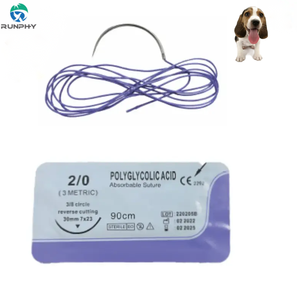
Yes. B2B buyers can configure any needle-and-thread pairing: thread sizes (USP 10-0 through USP 2), lengths (45cm to 150cm), needle curvatures (1/4, 3/8, 1/2, 5/8 circle, or straight), and point types (taper point, reverse cutting, conventional cutting, micro-spatula, diamond, or blunt point). Foil printing, box branding, and multi-language Instructions for Use (IFU) are fully customized.
Q4: What is the typical Minimum Order Quantity (MOQ) and production lead time?
Standard catalog inventory codes typically ship in 2 to 3 weeks. Private-label OEM packaging programs require initial artwork tooling, with first-run batch delivery times ranging between 4 to 6 weeks. Repeat OEM batches dispatch rapidly in 2 to 3 weeks.
Q5: How is needle attachment strength (pull-out force) tested during QC?
Every batch undergoes automated destructive pull testing on calibrated electronic tensile testers. The swage joint must meet or exceed USP and EP pull-out limits (e.g., USP 2-0 suture pull-out minimum requirement is 1.10 kgf for individual joint testing).
Q6: Are veterinary absorbable sutures manufactured under different standards than human sutures?
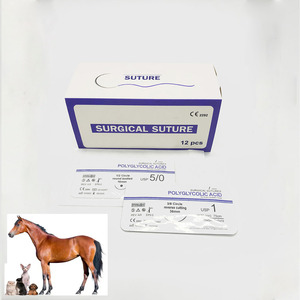
High-end veterinary surgical lines use identical medical-grade PGA/PGLA polymers, precision stainless steel needles, and EO sterilization cycles as human surgical lines. Packaging and labeling are tailored to veterinary clinical requirements, offering high performance for pet, equine, and livestock surgeries.
 Suture PlanetSurgical Wound Closure