1. Industry Overview: The Strategic Role of Catgut Sutures in Global B2B Sourcing
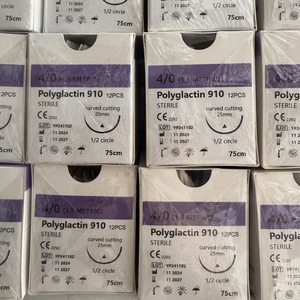
Despite the proliferation of synthetic absorbable polymers such as Polyglycolic Acid (PGA), Polyglactin 910, and Polydioxanone (PDO), Catgut Sutures—comprising both Plain Catgut and Chromic Catgut—maintain a vital, high-volume share in global surgical supply chains. Derived from purified natural collagen harvested from healthy bovine serosa or ovine submucosa, catgut remains the preferred tissue-closure material in specific clinical scenarios due to its unique enzymatic absorption mechanism, exceptional pliability, and cost-efficiency.
For B2B procurement managers, hospital consortiums, and medical device importers, navigating the global manufacturing ecosystem of natural collagen sutures requires an in-depth understanding of material science, raw material traceability, regulatory compliance (including ISO 13485:2016, CE / EU MDR 2017/745, and WHO-GMP), and manufacturer quality control rigor.
1.1 Plain vs. Chromic Catgut: Biochemical Mechanisms & Absorption Profiles
Catgut sutures are categorized based on their chemical surface treatment:
- Plain Catgut: Unmodified collagen fibers treated solely through enzymatic washing and mechanical twisting. Plain catgut exhibits rapid tensile strength loss in vivo (typically 50% loss within 7 to 10 days) and complete enzymatic digestion within 60 to 70 days. It is predominantly specified for fast-healing mucosa, ophthalmic procedures, and superficial animal surgery.
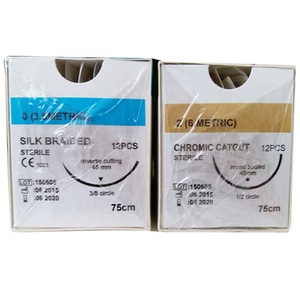
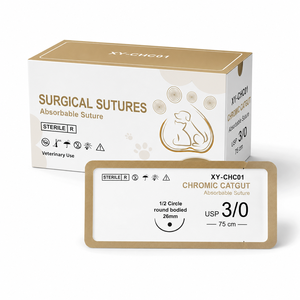
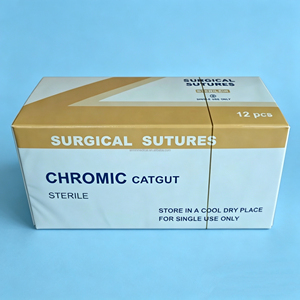
- Chromic Catgut: Treated with trivalent chromium salts (chromization). This chemical cross-linking of collagen filaments delays enzymatic breakdown by endopeptidases, extending tensile strength retention to 21–28 days and complete tissue absorption to 90–100 days. Chromic catgut provides crucial wound support in internal visceral closures, OB/GYN surgery, dental gingival adaptation, and veterinary abdominal wall approximation.
2. Technical Comparison: Natural vs. Synthetic Absorbable Sutures
To optimize inventory procurement and provide clear clinical guidance to hospital buyers, procurement officers must benchmark catgut sutures against synthetic alternatives. The table below outlines key engineering and physiological performance parameters:
| Suture Material Type |
Filament Structure |
In-Vivo Tensile Retention |
Mass Absorption Time |
Tissue Reaction Profile |
Primary B2B Application |
| Plain Catgut |
Twisted Natural Monofilament |
50% at 7–10 Days |
60–70 Days (Enzymatic) |
Moderate (Proteolytic) |
Mucosa, Dental, Fast Healing |
| Chromic Catgut |
Treated Natural Monofilament |
50% at 21–28 Days |
90–100 Days (Enzymatic) |
Controlled / Low-Moderate |
OB/GYN, GI Tract, Vet Surgery |
| PGA (Polyglycolic Acid) |
Braided & Coated Synthetic |
50% at 14–21 Days |
60–90 Days (Hydrolysis) |
Very Low (Inert) |
General Surgery, Orthopedics |
| Polyglactin 910 (Vicryl Eq.) |
Braided & Coated Synthetic |
50% at 21 Days |
56–70 Days (Hydrolysis) |
Very Low (Inert) |
Soft Tissue Approximation |
| PDO (Polydioxanone) |
Synthetic Monofilament |
50% at 28–35 Days |
180–210 Days (Hydrolysis) |
Minimal |
Fascia Closure, Vascular |
Key Takeaway for B2B Buyers: While synthetic sutures absorb predictably via hydrolysis independent of patient metabolic state, natural Chromic Catgut offers superior handling knot-pliancy, cost efficiency in high-volume markets, and rapid absorption in pediatric and veterinary applications where permanent foreign body retention is undesirable.
3. Global Procurement Trends & Sourcing Dynamics (2026–2030)
The global market for surgical sutures is undergoing significant structural shifts driven by stringent regulatory frameworks, geopolitical supply chain realignments, and expanding healthcare coverage in emerging economies.
3.1 Geographical Shift in OEM & ODM Manufacturing Hubs
Historically concentrated in Western Europe and North America, surgical suture manufacturing has undergone a massive migration to modern, vertically integrated hubs in India and Asian medical tech parks. Tier-1 manufacturers, such as Suture Planet (headquartered in Bengaluru, India), have established state-of-the-art cleanrooms (ISO Class 8 / Class 100,000) that combine high-precision automated needle-swaging, collagen extrusion, and ethylene oxide (EO) sterilization under single-site quality systems. This vertical integration reduces production lead times by 35% compared to fragmented supply chains.
3.2 Regulatory Rigor: Navigating EU MDR & BSE/TSE Certifications
Under the European Union Medical Device Regulation (EU MDR 2017/745), natural collagen sutures are subjected to stringent animal tissue origin checks. Leading factories must maintain complete BSE/TSE Free Risk Certification issued by EDQM or certified national health agencies. B2B buyers must prioritize manufacturers supplying comprehensive technical documentation, including:
- ISO 13485:2016 Quality Management System Certification.
- Full biocompatibility test reports per ISO 10993 series (cytotoxicity, sensitization, systemic toxicity).
- Validated Ethylene Oxide (EtO) sterilization cycle reports ensuring a Sterility Assurance Level (SAL) of 10⁻⁶ per ISO 11135.
- Free Sale Certificates (FSC) and WHO-GMP compliance for rapid ministry registration.
3.3 Surge in Veterinary & Animal Health Demand
The global veterinary healthcare market has experienced double-digit compound annual growth (CAGR). Chromic and Plain Catgut remain the single largest absorbable suture category in veterinary clinics, livestock care, and companion animal hospital networks. Strategic buyers are increasingly seeking factories offering dual-line packaging—medical-grade hospital configurations alongside private-label OEM veterinary packaging with custom USP sizes (USP 4-0 through USP 2) and specialized cutting needle geometries.
4. Next-Generation Technological Innovations in Catgut Manufacturing
Leading exporters are modernizing collagen processing techniques to eliminate traditional quality variances historically associated with natural gut sutures.
Enzymatic Purification & Automated Spinning
Advanced alkaline and enzymatic digestion protocols purify submucosa ribbons to >99% pure type-I collagen, eliminating cellular debris and non-collagenous proteins responsible for excessive tissue reaction.
Precision Chromic Salt Bath Calibration
Digitally controlled cross-linking tanks ensure uniform penetration of trivalent chromium ions throughout the strand core, preventing premature enzymatic degradation in high-collagenase tissue environments.
Laser-Drilled Hole Swaging Technology
Replacing traditional channel swaging with 3D laser-drilled needle attachment ensures ultra-smooth transition from needle to thread, significantly reducing tissue drag and pull-out failures exceeding USP tensile thresholds by 30%.
Single-Site Chain of Custody
From collagen ribbon preparation and precision braiding to stainless steel needle swaging, sterilisation, and double-foil barrier packaging—100% of operations run inside our Bengaluru facility.
Turnkey Registration Support
We supply complete regulatory dossiers including CE Technical Files, ISO 13485 certificates, Declarations of Conformity, Free Sale Certificates, and FSC documents legalised for your Ministry of Health.
Full OEM & Private Label Programs
Complete customization of needle geometry, thread length (45cm to 150cm), primary foil artwork, box branding, multi-language IFUs, and UDI/GS1 barcoding for importer brands.
5. Frequently Asked Questions (FAQ) for B2B Catgut Suture Buyers
Here are expert answers to the most common technical, commercial, and regulatory inquiries received by our global export desk:
What is the primary material source for your Catgut Sutures, and how is BSE/TSE risk mitigated?
Our Plain and Chromic Catgut sutures are manufactured strictly from purified bovine serosa or ovine submucosa harvested from certified healthy animals in BSE/TSE-free regions. Raw materials undergo rigorous veterinary inspection and chemical digestion protocols compliant with ISO 22442 (Medical devices utilizing animal tissues). Each batch is accompanied by an official BSE/TSE Free Certificate and Certificate of Analysis (CoA).
What are the typical shelf-life and storage requirements for sterile Chromic Catgut?
When packaged in primary hermetically sealed aluminum foil pouches containing a conditioning fluid (typically isopropyl alcohol and water mixture) and secondary peelable blisters, our catgut sutures maintain a validated shelf life of 5 years. Accelerated and real-time stability testing per ASTM F1980 confirms sterility and tensile maintenance when stored below 25°C away from direct moisture and thermal radiation.
Can you supply custom needle-and-thread combinations for private-label orders?
Yes. As an OEM manufacturer, we offer over 120 needle geometries in 300-series and 400-series surgical stainless steel—including 3/8 circle reverse cutting, 1/2 circle taper point, micro-spatula, and taper-cut configurations. Thread lengths can be tailored from 45 cm to 150 cm across USP sizes 6-0 to 2. Packaging foil and box packaging can be customized with your brand logo, corporate color scheme, and country-specific registration language.
What sterilization methodology is utilized, and how is residual EtO controlled?
Catgut sutures are sterilized using a validated Ethylene Oxide (EtO) process optimized for moisture-sensitive natural collagen. Cycle parameters are validated per ISO 11135 to achieve a Sterility Assurance Level (SAL) of 10⁻⁶. Degassing procedures guarantee that residual ethylene oxide and ethylene chlorohydrin levels remain far below the maximum permissible limits mandated by ISO 10993-7.
What are the standard lead times for catalog orders versus private-label OEM batches?
Standard catalog SKUs under our direct factory brand ship within 2 to 4 weeks from order confirmation. Private-label OEM orders requiring initial artwork approval and custom packaging plate printing typically take 5 to 7 weeks for the first batch. Repeat OEM orders benefit from safety stock arrangements and execute within 3 to 4 weeks.
What documentation is provided to support Ministry of Health (MoH) product registration?
We provide comprehensive registration dossiers that include: ISO 13485:2016 certificate, CE Declaration of Conformity, WHO-GMP certificate, Free Sale Certificate (FSC), detailed manufacturing process flowcharts, biocompatibility summary reports (ISO 10993), packaging integrity validation data, sample packaging foils, and detailed Instructions for Use (IFU) in English, Spanish, French, Arabic, or Portuguese.
How does needle attachment pull-out testing ensure intraoperative safety?
Every single production lot undergoes rigorous destructive pull-out testing using calibrated automated tension testing machinery. Needle swage attachment strength is verified against USP and European Pharmacopoeia (EP) monograph standards, ensuring zero needle detaching during penetration through tough tissue or muscle fascia.
 Suture PlanetSurgical Wound Closure