
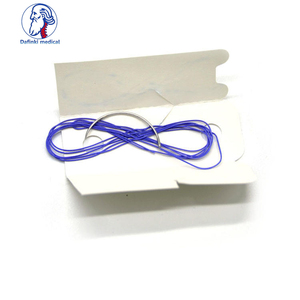
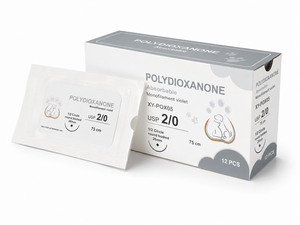
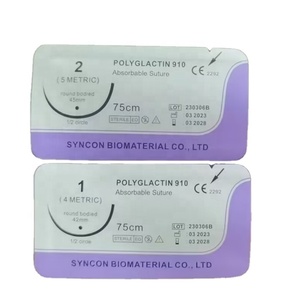
1. Executive Summary & Material Science of Nylon (Polyamide) Sutures
Nylon surgical sutures—classified polyamides derived from long-chain synthetic polymers—remain the gold standard in non-absorbable monofilament wound closure. Within clinical practice and B2B medical supply chains, Nylon sutures are primarily available in two chemical variations: Polyamide 6 (Polycaprolactam) and Polyamide 6,6 (Polyhexamethylene adipamide). Both variants offer exceptional tensile strength, minimal tissue reaction, and superior smooth passage through delicate anatomical structures during microsurgery, ophthalmic procedures, plastic surgery, and skin closure.
From a polymer physics perspective, Nylon monofilament sutures possess high intrinsic memory due to their semi-crystalline molecular orientation. While this memory requires proper surgical knot-tying technique (such as a square knot with extra throws), it provides unmatched dynamic elasticity, accommodating post-operative tissue edema without cutting into subcutaneous margins. Although classified as non-absorbable under United States Pharmacopeia (USP) monographs, Nylon undergoes slow in-vivo progressive hydrolysis at a rate of approximately 15% to 20% tensile loss annually, eventually encapsulating harmlessly within fibrous connective tissue.
Technical Insight for Procurement Directors: Unlike braided non-absorbable sutures (e.g., Silk or Polyester) which carry capillary risks of harboring micro-organisms, Nylon monofilaments exhibit non-capillary properties. This renders Nylon the material of choice for contaminated or infection-prone surgical sites, skin approximation, and veterinary dermal closures.
2. Quantitative Evaluation Rationale: Top 10 Nylon Suture Manufacturers Criteria
Navigating the global market for reliable surgical suture suppliers requires strict technical evaluation beyond simple unit pricing. Hospitals, OEM brand owners, and tender agencies must assess manufacturers using a five-dimensional quality framework based on ISO 13485:2016 and EU MDR 2017/745 mandates:
Swage Pull-Out Strength
Exceeding USP & EP minimum requirements for needle-to-thread attachment tolerances, ensuring zero detachment during deep tissue manipulation.
Cleanroom Class 8 Precision
Controlled environmental extrusion and micro-swaging within ISO Class 8 (Class 100,000) cleanrooms to eliminate bioburden prior to sterilisation.
EtO Residual Control
Validated 100% Ethylene Oxide (EtO) sterilisation cycles with residual limits strictly below ISO 10993-7 thresholds to protect tissue viability.
Needle Point Retention
Siliconised 300-series stainless steel needles (AISI 302/304/420) engineered for smooth initial penetration force and low drag across repeated passes.
Full Lot Traceability
Granular batch tracking linking raw resin melt index, monofilament diameter profile, swage tension records, and final sterility release certificates.
Regulatory Technical Files
Comprehensive CE MDR technical documentation, Free Sale Certificates (FSC), and Certificate of Analysis (CoA) ready for fast authority approvals.
3. Technical Benchmark: Nylon Monofilament vs. Alternative Surgical Polymers
Selecting the appropriate wound closure device requires comparing material performance metrics under simulated clinical stresses. The matrix below outlines how non-absorbable Nylon monofilaments perform against both absorbable (PGA, PGLA, PDO) and non-absorbable (Polypropylene, Silk) materials:
| Polymer / Material | Structure Type | Tensile Strength Loss (In-Vivo) | Absorption Profile | Tissue Reactivity | Primary Clinical Indications |
|---|---|---|---|---|---|
| Nylon / Polyamide 6 / 6.6 | Monofilament | 15–20% per year (slow hydrolysis) | Non-Absorbable (Encapsulated) | Very Low | Skin closure, Plastic Surgery, Ophthalmology, Micro-surgery |
| Polypropylene (PP) | Monofilament | 0% (Indefinite retention) | Non-Absorbable | Extremely Low | Cardiovascular, Hernia Mesh Fixation, Vascular Anastomosis |
| Black Braided Silk | Braided (Protein) | 50% at 1 year / 100% at 2 years | Non-Absorbable (Gradual) | Moderate to High | Dental, Ligation, General Soft Tissue (Non-infected) |
| Polyglycolic Acid (PGA) | Braided & Coated | approx 35% loss at 14 days | 56–70 Days (Hydrolysis) | Minimal | Gynaecology, General Surgery, Veterinary Subcuticular |
| Polyglactin 910 (PGLA) | Braided & Coated | approx 25% loss at 14 days | 56–70 Days (Hydrolysis) | Minimal | Gynaecology, Ophthalmic Vicryl Equivalent, Vet Surgery |
| Polydioxanone (PDO/PDS) | Monofilament | approx 30% loss at 14 days / 50% at 28 days | 180–210 Days (Hydrolysis) | Very Low | Fascia Closure, Pediatric Cardiac, Abdominal Wall |
4. Strategic OEM Advantages of Single-Site Manufacturing
For B2B procurement leaders and international medical brand owners, sourcing surgical sutures from a fully vertically integrated manufacturer significantly reduces operational risk, quality variance, and supply chain disruptions. Factories operating under unified single-site quality management offer strategic operational benefits:
1. Raw Material Monofilament Extrusion Precision: In-house extrusion of medical-grade Polyamide 6/6.6 resin pellets guarantees uniform strand diameter compliance across USP 11-0 through USP 2 sizes. Automated laser micrometer feedback loops eliminate diameter fluctuations, ensuring consistent linear tensile strength.
2. Micro-Swaging & Laser-Drilled Needles: Attaching surgical needles to non-absorbable monofilaments requires micro-precision. Laser-drilled needle ends provide a smooth 1:1 transition ratio between thread and needle diameter, minimizing tissue trauma upon insertion. Swage pull-out testing is conducted on 100% of production lots to eliminate intra-operative needle detachments.
3. Sterile Barrier Packaging Integrity: Suture Planet and partner manufacturing hubs utilize primary medical-grade aluminum foil packaging coupled with peel-open Tyvek/film envelopes. This dual-barrier construction protects Nylon sutures from moisture ingress (preventing premature polymer degradation) and maintains validated 5-year shelf-life sterility under ambient tropical storage conditions.
5. Future Sourcing & Technology Trends in Surgical Sutures (2025–2030)
The global wound-closure market is expanding beyond basic tissue approximation toward functionalized, smart, and knotless closing vectors. Procurement teams preparing their multi-year supply strategies should monitor four key technology shifts:
A. Antibacterial Functionalized Coatings: Chlorhexidine and Triclosan-coated monofilament Nylon and PGA sutures are increasingly specified in government hospital procurement tenders to reduce Surgical Site Infections (SSIs). Future formulations focus on non-antibiotic bio-active peptide coatings.
B. Micro-Barbed Knotless Nylon Vectors: Barbed Nylon monofilaments feature unidirectional or bidirectional cut barbs that distribute tissue tension evenly along the wound line without requiring knot tying. This innovation cuts operative closure time by up to 50% in plastic, reconstructive, and orthopedic procedures.
C. Automated AI Vision Inspection: Leading manufacturers are replacing manual loupe inspection with high-speed AI machine vision lines. Every needle point geometry, curvature angle, and swage crimp is digitally scanned to achieve zero-defect quality thresholds prior to primary packaging.
D. EU MDR 2017/745 Compliance & EUDAMED Integration: Global regulatory compliance is tightening. Importers are migrating away from suppliers with legacy MDD certificates toward manufacturers with full EU MDR Class IIb technical dossiers, verified Clinical Evaluation Reports (CER), and Unique Device Identification (UDI) barcode alignment.