Certified Medical Devices
Flagship Antibacterial & Synthetic Surgical Sutures
Explore high-performance antimicrobial wound closure solutions manufactured under strict ISO 13485:2016 and CE / EU MDR standards for worldwide export.
PGA Veterinary
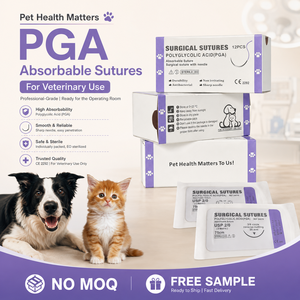
Professional Sterile Polyglycolic Acid Sutures for Veterinary Procedures (12PCS)
- Durable Non-Irritating Sharp Needle
- Broad Spectrum Antibacterial Protection
- Hydrolytic Absorption (60-90 Days)
Get a Quote
CETTIA Series
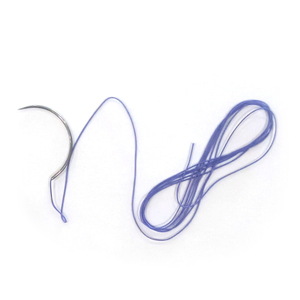
CETTIA KD911 Veterinary Medical Disposable Antibacterial Suture Thread
- Triclosan Coated Micro-Filament
- High Initial Tensile Strength
- Pre-swaged 300-Series Steel Needle
Get a Quote
PGLA / PGCL
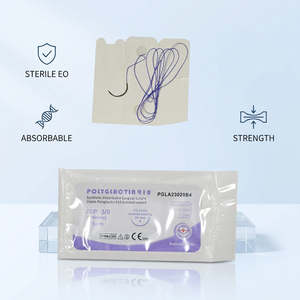
Medical Synthetic Sterilised Surgical Polyglycolic Acid PGLA / PGCL Suture Thread
- Polycaprolactone-Coated Surface
- Smooth Passage Through Soft Tissue
- Ethylene Oxide Sterilized (SAL 10⁻⁶)
Get a Quote
Non-Invasive
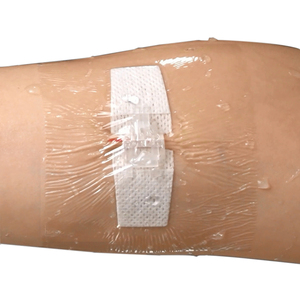
Sterile Waterproof Bacteria-Resistant Zipper Stitch Suture Strips
- Hypoallergenic Polyurethane Film
- Tension Reduction Zipper Mechanism
- Needle-Free Rapid Wound Closure
Get a Quote
Surgical Kit
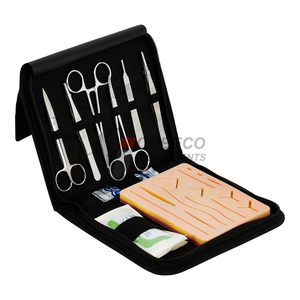
Antimicrobial Suture Kits with Coated Materials & Sterile Procedure Components
- Complete SSI Infection Control Tray
- Customized Needle-Suture Bundles
- Full Regulatory Audit Documentation
Get a Quote
PGA Absorbable
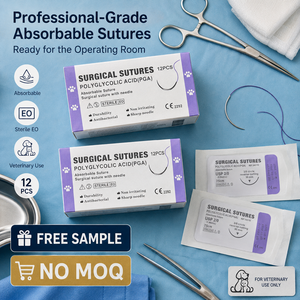
Veterinary Grade Polyglycolic Acid Absorbable Sutures Sterile Pack (12PCS)
- Precision Taper-Cut & Reverse Cutting
- Non-Capillary Braided Architecture
- Minimal Tissue Reactivity Profile
Get a Quote
Monofilament
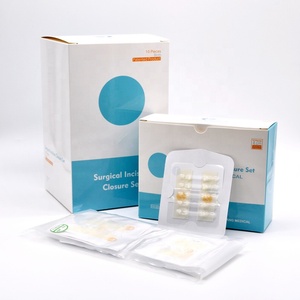
Absorbable & Non-Absorbable Nylon Monofilament Surgical Medical Sutures
- Wide Range USP 10-0 to USP 2
- High Elasticity & Knot Security
- Optimal Subcuticular Closure Performance
Get a Quote
CE & ISO Certified
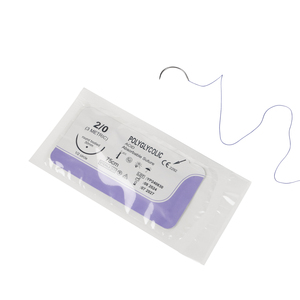
CE ISO Certified Medical Surgical Polyglycolic Acid Suture with Needle
- Hospital & Operating Room Grade
- Traceable Batch & Polymer Lots
- Double Foil Vacuum Sealed Pack
Get a Quote
60%
Average SSI Reduction Rate with Antimicrobial Coating
50+
Global Healthcare Import Markets Served
10⁻⁶
Sterility Assurance Level (SAL via EO Process)
100%
In-House Single-Site Manufacturing Traceability
Clinical & Bio-Material Whitepaper
The Evolution of Antibacterial Wound Closure: Mitigating Surgical Site Infections (SSIs)
Surgical Site Infections (SSIs) remain among the most challenging healthcare-associated complications worldwide, accounting for substantial patient morbidity, prolonged hospital stays, and elevated healthcare expenditure. Studies indicate that surgical sutures—acting as foreign material introduced into sterile tissue—can serve as a nidus for microbial colonization and biofilm formation. Microorganisms such as Staphylococcus aureus, Staphylococcus epidermidis, and methicillin-resistant strains rapidly adhere to untreated thread matrices.
Modern antimicrobial sutures incorporating high-purity Triclosan (5-chloro-2-(2,4-dichlorophenoxy)phenol) establish a robust Zone of Inhibition (ZOI) surrounding the wound baseline. By inhibiting bacterial fatty acid synthesis (specifically targeting the Enoyl-Acyl Carrier Protein Reductase enzyme FabI), antibacterial sutures proactively prevent bacterial adherence during the critical 7-to-14-day postoperative wound healing window.
Information Gain Insight: Clinical meta-analyses across abdominal, orthopedic, and cardiovascular surgeries confirm that switching from conventional absorbable braids to broad-spectrum antimicrobial polyglactin 910 or PGA sutures lowers relative SSI risks by up to 39% to 60%. Sourcing compliant, multi-certified antimicrobial closure devices is no longer optional—it is an economic and clinical imperative for modern medical device procurement.
Engineering Specifications
Synthetic Absorbable & Non-Absorbable Material Matrix
A granular comparison of bio-absorbability, chemical composition, tensile degradation kinetics, and clinical indications for hospital tenders and OEM specifications.
| Material Family |
Polymer Structure |
Tensile Strength Retention |
Complete Mass Absorption |
Antibacterial Agent |
Primary Clinical Indications |
| Polyglycolic Acid (PGA) |
Synthetic Braided & Coated |
~75% at 14 Days
~50% at 21 Days |
60 – 90 Days (Hydrolysis) |
Triclosan (Optional) |
General Soft Tissue, Veterinary Procedures, Gastrointestinal Closure |
| Polyglactin 910 (PGLA) |
Coated Glycolide-Lactide Copolymer |
~75% at 14 Days
~50% at 21 Days |
56 – 70 Days (Hydrolysis) |
Triclosan (≤ 472 μg/m) |
OB/GYN, Ophthalmic, Pediatric, Plastic & Reconstructive Surgery |
| Poliglecaprone 25 (PGCL) |
Monofilament Glycolide & ε-Caprolactone |
~50% to 60% at 7 Days
~20% to 30% at 14 Days |
91 – 119 Days (Hydrolysis) |
Surface Coated |
Subcuticular Skin Closure, Low-Tension Soft Tissue Approximation |
| Polydioxanone (PDO/PDS) |
Monofilament Polyester Polymer |
~70% at 14 Days
~50% at 28 Days |
180 – 210 Days (Slow Hydrolysis) |
Integrated Matrix |
Abdominal Wall Fascia, Pediatric Cardiovascular, Orthopedic Ligaments |
| Nylon / Polyamide |
Non-Absorbable Monofilament |
Gradual Loss (15-20% per year) |
Permanent Implant |
Antimicrobial Finish |
Cuticular Skin Closure, Microsurgery, Ophthalmic Procedures |
| Polyurethane Zipper Strips |
Adhesive Non-Invasive Film |
Constant Exterior Retention |
N/A (Exfoliated / Removed) |
Hypoallergenic Barrier |
Needle-Free Surgical Incision Closure, Cosmetic Scar Reduction |
Manufacturing Integrity & Chain of Custody
Why Global Procurement Directors Choose Suture Planet
Operating out of state-of-the-art medical technology infrastructure in Bengaluru, Karnataka, India, Suture Planet represents single-site operational excellence. We bridge high-precision European manufacturing standardizations with scalable export capabilities, delivering certified medical devices to over 50 countries across Asia-Pacific, the Middle East, Africa, Europe, and Latin America.
Full Regulatory Dossiers
Every shipment comes supported by complete ISO 13485:2016, CE / EU MDR 2017/745, ISO 9001:2015, and WHO-GMP documentation, alongside Free Sale Certificates (FSC) for fast ministry registration.
Single-Site Traceability
From raw synthetic polymer extrusion and precision braiding to laser drilling, 300-series needle swaging, and Ethylene Oxide (EO) sterilization, all operations run inside one controlled facility for 100% batch accountability.
Custom OEM & Private Label
We engineer customized needle-and-thread combinations matching exact hospital tender specifications: thread lengths (45cm–150cm), USP sizes (10-0 to 2), custom needle geometries, and multi-language packaging.
Strategic Sourcing Analysis
Global Sourcing & Future Industry Development Trends (2025–2030)
1. Acceleration of Barbed Knotless Antibacterial Sutures
Traditional surgical suturing relies heavily on manual knot tying, which introduces tension variance and potential ischemic necrosis around tissue borders. The global market is rapidly shifting toward bidirectional barbed monofilament sutures impregnated with antibacterial agents. This design eliminates knot-tying steps, reduces operating room (OR) closure time by up to 35%, and maintains uniform tension distribution across fascia and dermal incisions.
2. Regulatory Harmonization & Stringent Technical Files
With the transition from Europe's MDD to the EU MDR 2017/745 framework, regulatory bodies worldwide are demanding rigorous clinical evaluation reports (CER), Post-Market Clinical Follow-up (PMCF) data, and strict toxicity profiling (ISO 10993). Importers are migrating away from unverified suppliers toward audited manufacturers capable of providing valid technical dossiers and proof of EO sterilizer gas residue compliance (ISO 10993-7).
3. Transition to Non-Invasive Zipper & Hybrid Closures
In cosmetic, pediatric, and outpatient surgeries, tension-reducing adhesive micro-zipper strips are gaining market share. By serving as a non-invasive primary or secondary closure mechanism over subcutaneous absorbable sutures, these devices mitigate needle-stick injury risks for healthcare staff while eliminating micro-track scarring and secondary hospital visits for suture removal.
4. Green Sterilization & Sustainable Polymer Chemistry
Leading global healthcare systems are mandating environmental compliance across their supply chain. Future trends emphasize low-emission Ethylene Oxide sterilization cycles, recyclable aluminum-foil packaging barriers, and zero-waste synthesis of glycolide and lactide monomers, ensuring medical grade compliance without ecological compromise.
Procurement Knowledge Base
Frequently Asked Questions (FAQ) for Medical Importers & B2B Buyers
Essential answers regarding regulatory certificates, shelf life, OEM capabilities, and procurement lead times for surgical suture tenders.
What specific certificates and regulatory files are provided for international product registration?
We provide full regulatory registration dossiers including ISO 13485:2016 certificate, CE / EU MDR Declaration of Conformity, ISO 9001:2015, WHO-GMP compliance, Free Sale Certificate (FSC), Certificate of Analysis (CoA) for each batch, ISO 10993 biocompatibility test reports, and Ethylene Oxide (EO) sterilization validation reports (SAL 10⁻⁶).
How does Triclosan antibacterial coating remain stable throughout product shelf life?
The Triclosan active agent is micro-encapsulated into the synthetic polycaprolactone coating applied to the suture thread. Stored inside protective vacuum-sealed aluminum foil primary packaging, the chemical matrix resists degradation, maintaining full antimicrobial efficacy and a guaranteed 5-year shelf life under standard storage conditions (below 25°C).
Can Suture Planet manufacture OEM and private-label suture lines for distributor brands?
Yes. We specialize in private-label manufacturing. Buyers can specify needle curvature (1/2, 3/8, 1/4, 5/8 circle), point geometries (taper-point, reverse cutting, taper-cut, spatula), thread colors (violet, blue, undyed), foil layout, outer box branding, multi-language Instructions for Use (IFU), and UDI/GS1 barcode printing.
What are typical minimum order quantities (MOQ) and production lead times for export orders?
Standard catalogue product codes usually ship within 2 to 4 weeks. For OEM or private-label orders requiring customized packaging artwork plates and specific needle-thread pairings, initial production runs require 5 to 7 weeks. Repeat batch cycles ship faster once packaging plates are archived.
How is needle attachment strength tested and verified prior to release?
Every production lot undergoes rigorous mechanical testing on calibrated tensile testing instruments in accordance with United States Pharmacopeia (USP) and European Pharmacopoeia (EP) monograph standards. Swage pull-out forces must meet or exceed minimum N (Newton) tension requirements before lot release.
What is the difference between Polyglycolic Acid (PGA) and Polyglactin 910 (PGLA) sutures?
Both are synthetic braided absorbable sutures offering comparable tensile strength profiles (~75% at 14 days). However, PGA is synthesized from 100% pure polyglycolic acid, whereas PGLA is a copolymer of 90% glycolide and 10% L-lactide. PGLA typically features a slightly smoother polycaprolactone coating, making it preferred for delicate ophthalmic and pediatric surgeries.
Partner with a Certified Antibacterial Suture Manufacturer
Streamline your hospital supply chain with direct factory pricing, rapid tender document delivery, and world-class surgical device quality.
Get a Quote
 Suture PlanetSurgical Wound Closure