Strategic Technical Analysis: Surgical Suture Export Framework for Moscow Healthcare Infrastructure
The procurement landscape for surgical wound closure devices across Moscow and the broader Central Federal District of Russia is experiencing a structural evolution. Municipal clinical networks, federal scientific research institutes (such as the Bakulev National Medical Research Center for Cardiovascular Surgery and the Sklifosovsky Institute for Emergency Medicine), alongside specialized private surgical and veterinary clinics, demand strictly validated medical consumables. As an established, ISO 13485:2016-certified surgical sutures manufacturer and primary exporter, our manufacturing infrastructure supplies highly consistent, USP-compliant surgical threads, absorbable polymers, and precision stainless steel needles direct to Moscow importers and medical tender holders.
Navigating the requirements of Roszdravnadzor (Federal Service for Surveillance in Healthcare) and the Eurasian Economic Union (EAEU) medical device framework demands technical documentation depth, batch-to-batch polymer integrity, and uncompromising sterility assurance. This industry whitepaper outlines the biomechanical performance, polymer degradation chemistry, localized clinical utility, and regulatory export mechanisms governing surgical suture supplies imported into Moscow.
Key Takeaway for Moscow Medical Procurement Officers
Surgical sutures imported into Moscow must balance superior tensile strength retention with documented biocompatibility (ISO 10993 series). Our single-site manufacturing model in Bengaluru integrates extrusion, braiding, coating, precision needle swaging, and validated Ethylene Oxide (EO) sterilization under one quality management system, eliminating supply chain fragmentation and ensuring 100% batch traceability back to raw resin lots.
Polymer Metallurgy, Degradation Chemistry & Tribology
Surgical suturing requires selecting the precise material dynamics based on tissue healing velocity, enzymatic or hydrolytic exposure, and anatomical shear stress. Suture materials fall into two primary mechanical classifications: absorbable (synthetic and organic) and non-absorbable polymers.
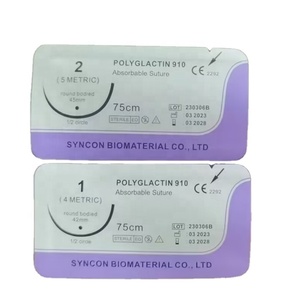
1. Synthetic Absorbable Sutures: PGA & Polyglactin 910 (PGLA)
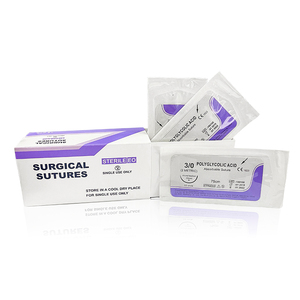
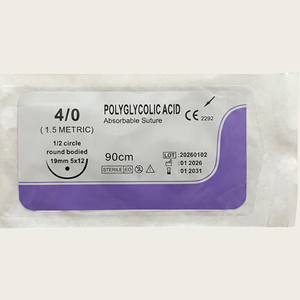
Synthetic absorbable sutures dominate soft tissue approximation in modern surgical protocols across Moscow hospitals. Polyglycolic Acid (PGA) and Polyglactin 910 (PGLA) (composed of 90% glycolide and 10% L-lactide) undergo degradation via monomeric hydrolysis rather than enzymatic digestion. This predictable breakdown mechanism minimizes localized inflammatory reactions compared to traditional catgut materials.
- Tensile Retention Kinetics: Polyglactin 910 maintains approximately 75% of its original breaking strength at 14 days post-implantation, decreasing to ~50% at 21 days and ~25% at 28 days. Complete absorption through hydrolytic metabolic pathways typically occurs within 56 to 70 days.
- Coating Mechanics: Braided filaments are treated with Poly(glycolic-co-L-lactic acid) and Calcium Stearate coatings. This tribological modification reduces surface friction, enabling smooth passage through delicate parenchymal tissue without tissue sawing ("chatter") while retaining high knot security upon tensioning.
- Antibacterial Variant Options: For high-risk surgical fields, sutures coated with broad-spectrum antimicrobial agents (such as Triclosan) are manufactured to inhibit colonization by Staphylococcus aureus and Staphylococcus epidermidis.
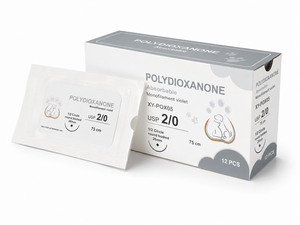
2. Extended-Support Monofilaments: Polydioxanone (PDO / PDS)
For tissue requiring prolonged mechanical support—such as abdominal wall fascia, pediatric cardiovascular constructs, or orthopedic tendon reattachments—Polydioxanone (PDO) monofilament sutures represent the gold standard material. PDO exhibits slow hydrolytic breakdown:
- Strength Profile: Retains roughly 70% tensile strength at 14 days, 50% at 28 days, and 25% at 42 days, with complete hydrolytic absorption achieved within 180 to 210 days.
- Pliability Engineering: Monofilament extrusion technology yields low memory effect, preventing coiling and facilitating precise surgeon handling during complex oncological or reconstructive procedures.
3. Non-Absorbable Monofilaments & Braids: Polypropylene, Nylon & Silk
Permanent wound closure requiring lifelong bio-inert stability relies on non-absorbable suture polymers:
- Polypropylene (Monofilament): Highly inert isotactic polypropylene monofilament exhibits zero degradation in tissue. It is the material of choice for Moscow vascular surgeons executing arterial anastomoses and hernia mesh fixation, providing smooth knot elongation without fraying.
- Polyamide / Nylon (Monofilament): Extruded nylon offers uniform diameter and exceptional elasticity, making it ideal for dermal skin closure and plastic surgery where cosmetic scarring must be minimized.
- Braided Silk: Specially treated virgin silk filaments braided and coated with wax or silicone provide superior tactile feedback and knot stability in neurosurgical, oral, and general ligation settings.
Comparative Technical Matrix: Absorbable & Non-Absorbable Suture Range
| Material Class |
Structure |
Tensile Strength Profile |
Absorption / Mass Loss |
Primary Clinical Applications in Moscow |
| Polyglactin 910 (PGLA) |
Braided & Coated |
~75% at 14 Days / ~50% at 21 Days |
56 - 70 Days (Hydrolysis) |
General Surgery, OB/GYN, Gastrointestinal, Urology |
| Polyglycolic Acid (PGA) |
Braided & Coated |
~65% at 14 Days / ~40% at 21 Days |
60 - 90 Days (Hydrolysis) |
Soft Tissue Approximation, Ophthalmic, Orthopedics |
| Polydioxanone (PDO) |
Monofilament |
~70% at 14 Days / ~50% at 28 Days |
180 - 210 Days (Hydrolysis) |
Fascial Closure, Pediatric Cardiac, Abdominal Wall |
| Chromic Catgut |
Twisted Organic Collagen |
~50% at 10-14 Days |
90 Days (Enzymatic Digestion) |
Veterinary Surgery, Mucosal Closure, Short-term Ligation |
| Polypropylene |
Monofilament |
Permanent (0% Loss Over Time) |
Non-Absorbable (Bio-inert) |
Cardiovascular Anastomosis, Hernia Repair, Vascular |
| Nylon / Polyamide |
Monofilament |
Gradual Loss (~15-20%/yr) |
Non-Absorbable |
Cuticular Skin Closure, Plastic & Reconstructive |
Needle Geometry & Stainless Steel Metallurgy
Suture thread integrity must be paired with precision needle manufacturing to minimize surgical trauma. Our needles are crafted from high-tensile 300-series (e.g., AISI 302/304) and 400-series siliconized stainless steel alloys engineered to resist bending and burring under dense fascial loads.
- Swage Pull-Out Attachment: Utilizing automated micro-drilled laser swaging, the transition between needle and thread is streamlined. Every manufacturing batch undergoes USP pull-out tension testing to guarantee that swage holding force far exceeds minimum monograph limits.
- Needle Point Curvatures: Complete options including 3/8 circle, 1/2 circle, 1/4 circle, and straight needles, fitted with point profiles such as Taper Point (TP), Reverse Cutting (RC), Micro-Point Spatulated, and Tapercut (TC) geometries tailored for delicate vascular or tough fibrous tissues.
Localized Clinical & Veterinary Application Scenarios in Moscow
Moscow serves as the premier hub for specialized medical care in Eastern Europe, housing over 100 major public medical centers, municipal clinical hospitals (Gorodskaya Klinicheskaya Bolnitsa), and private health networks (such as Medsi, K-31, and EMC). Additionally, Moscow's veterinary market represents the largest urban animal care market in Russia, requiring dedicated surgical supplies.
1. Municipal Operating Theaters & Federal Tender Supply
Public health purchasing in Moscow operates via structured federal state tenders (under Law No. 44-FZ and 223-FZ frameworks). Key requirements for imported surgical suture shipments include:
- Uniform lot consistency across high-volume sterile boxes (12, 24, or 36 units per carton).
- Extended shelf-life stability (5 years) certified under accelerated and real-time aging validation.
- Sterile foil barrier integrity capable of enduring logistics transportation across varied thermal environments.
2. Moscow Veterinary Clinical Networks
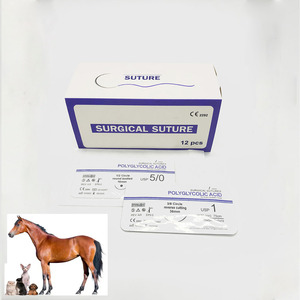
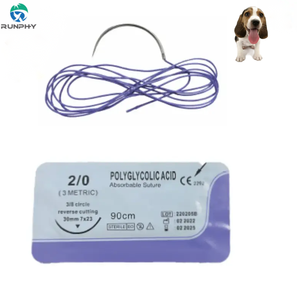
With high density companion animal care centers (dogs, cats, exotic pets) across Moscow administrative okrugs (Central, Northern, South-Western), veterinary surgeons heavily utilize PGA and PGLA 910 absorbable sutures in sizes USP 4-0, 3-0, and 2-0. Fast absorption kinetics, predictable knot strength during spay/neuter operations, and cost-effective bulk distribution packaging are critical requirements for Moscow veterinary distributors.
3. Plastic & Cosmetic Reconstructive Surgery
Private cosmetic surgical clinics operating in central Moscow require ultrafine monofilament sutures (USP 5-0 to 7-0 Polypropylene and Nylon) equipped with precision cutting spatulated needles. Low tissue drag and minimal scar reactivity are required for facial plastic procedures and aesthetic revisions.
Regulatory Compliance, Roszdravnadzor Dossiers & Quality Management
Exporting medical devices to Moscow requires adherence to international quality management protocols and local Russian regulatory standards:
Comprehensive Documentation Package Supplied for Moscow Authorization
- ISO 13485:2016 Certification: Full scope coverage for the design, extrusion, swaging, packaging, and sterilization of absorbable and non-absorbable surgical sutures.
- CE Marking & EU MDR Technical Files: Annex IX / VII technical documentation including General Safety and Performance Requirements (GSPR) checklists and clinical evaluation reports (CER).
- Biocompatibility (ISO 10993 Series): Complete toxicological profiles covering Cytotoxicity (ISO 10993-5), Sensitization & Irritation (ISO 10993-10), Systemic Toxicity (ISO 10993-11), and Hemocompatibility.
- EO Sterilization Validation (ISO 11135): Process validation reports demonstrating a Sterility Assurance Level ($10^{-6}$ SAL) with ethylene oxide residual limits tested below standard limits per ISO 10993-7.
- Legalized Certificates of Free Sale (CFS): Officially notarized and apostilled export documentation ready for Russian consular clearance.
Export Supply Chain, Customs Clearance & Freight Corridors to Moscow
Executing reliable delivery into the Moscow region requires robust freight routing and customs paperwork accuracy. As an experienced exporter, our international logistics desk manages export fulfillment directly to Moscow importers:
- Air Cargo Routes: Direct expedited air freight shipments dispatched to Sheremetyevo Cargo (SVO), Domodedovo Cargo (DME), or Vnukovo Cargo (VKO) terminals for urgent clinical contracts and private clinic restocking.
- Multimodal & Rail Freight: Ocean freight to regional ports consolidated with rail corridors for cost-effective bulk order shipments destined for Moscow distribution warehouses.
- Customs HS Code Standardization: Standardized classification under international HS Codes (e.g., 3006.10 for sterile surgical sutures and suture needles) ensuring clear customs declarations at Moscow customs posts.
- Temperature-Controlled Packaging: Cold-chain and thermal protection packaging option preventing premature polymer degradation during transit across sub-zero winter temperatures typical of Northern transport routes.
 Suture PlanetSurgical Wound Closure